

Last Diwali, a family in a Model Town society did everything right. Their own crackers were lit far away from the house, in the open, with a bucket of water sitting close by, just in case. And still, their nine-year-old daughter got hurt. She was standing on her own balcony, nowhere near a lit fuse, when a rocket from two floors below veered sideways instead of going up, and a spark caught her eye. Nobody in that family had done anything wrong. That’s the part most Diwali safety advice forgets to mention — a large share of firecracker eye injuries happen to people who never lit a single cracker themselves.
This isn’t meant to scare you away from Diwali. It’s meant to help you celebrate it the way it deserves — with light, not with a trip to the emergency room. Here’s what actually helps, in plain terms.
Why an Eye Injury Is Never a "Wait and See" Kind of Injury
A burn on the hand is painful, but it heals. An eye doesn’t always get that second chance.
Doctors who studied firecracker eye injuries across hospitals in Central and Western India during a recent Diwali season found something worth sitting with: most of the injured were children, most injuries came from a sudden blast rather than direct contact, and by the time patients actually reached a hospital, the average wait had already stretched past six hours. By then, more than four in ten patients had already lost a serious amount of vision in that eye — and almost a quarter needed surgery just to repair the damage.
A separate study, this one following children over five years at a hospital in South India, found something even harder to read: for every twelve children brought in with a firecracker eye injury, one lost sight permanently in that eye. Among all the ways a firecracker can hurt someone, the eyes are the second most commonly injured part of the body — right after the hands.
None of this is meant to frighten you. It’s meant to explain why the next few minutes after an injury matter as much as they do.
Where These Injuries Actually Happen in Jalandhar
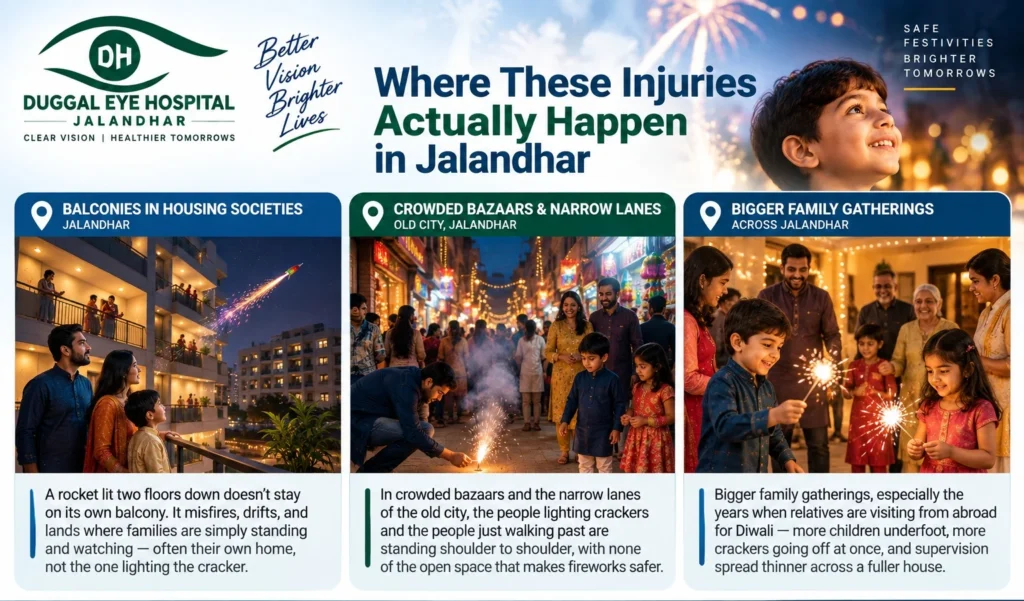
Two things about how Diwali is celebrated here make bystanders more likely to get hurt, not less:
- Balconies in newer housing societies. A rocket lit two floors down doesn’t stay on its own balcony. It misfires, drifts, and lands where families are simply standing and watching — often their own home, not the one lighting the cracker.
- Crowded bazaars and the narrow lanes of the old city, where the people lighting crackers and the people just walking past are standing shoulder to shoulder, with none of the open space that makes fireworks safer.
- Bigger family gatherings, especially the years when relatives are visiting from abroad for Diwali — more children underfoot, more crackers going off at once, and supervision spread thinner across a fuller house.
None of this means staying indoors. It means choosing where you stand as carefully as you choose what you light.
A Few Simple Rules That Genuinely Help
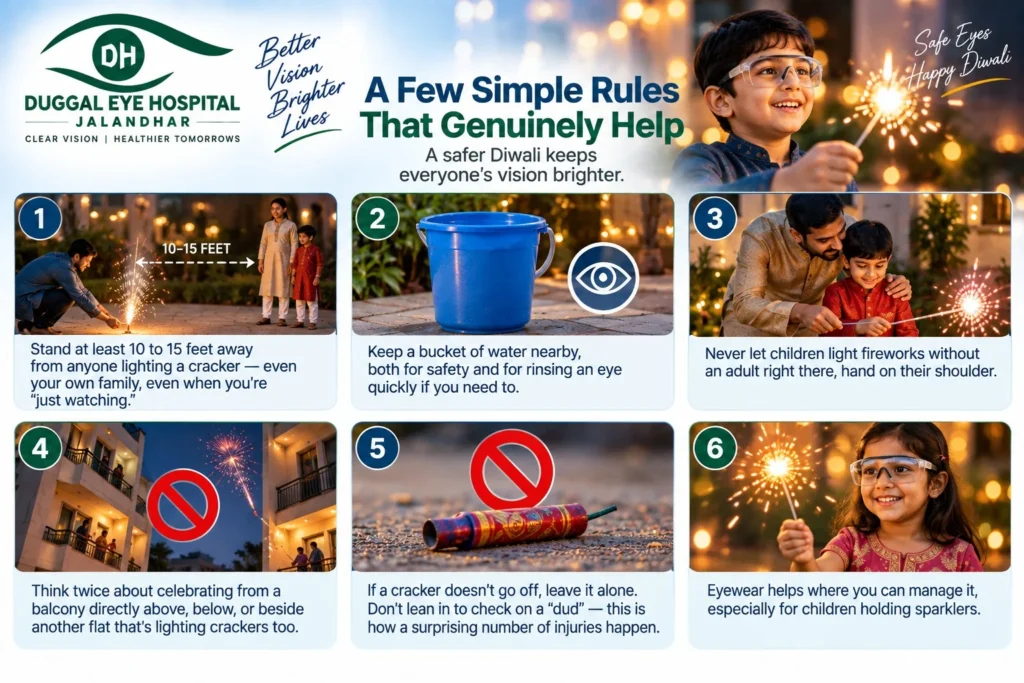
- Stand at least 10 to 15 feet away from anyone lighting a cracker — even your own family, even when you’re “just watching.”
- Keep a bucket of water nearby, both for safety and for rinsing an eye quickly if you need to.
- Never let children light fireworks without an adult right there, hand on their shoulder.
- Think twice about celebrating from a balcony directly above, below, or beside another flat that’s lighting crackers too.
- If a cracker doesn’t go off, leave it alone. Don’t lean in to check on a “dud” — this is how a surprising number of injuries happen.
- Eyewear helps where you can manage it, especially for children holding sparklers.
If It Happens Anyway: The First Few Minutes
What you do right after an eye injury changes what happens next — so it helps to know this before Diwali night, not while you’re panicking in the middle of it.
Just smoke or a stinging feeling, nothing visibly stuck in the eye? Rinse gently with clean water for a few minutes. If the stinging or blurriness doesn’t settle down, go get it looked at.
Something feels lodged in the eye? Don’t rub it. Don’t try to pick it out yourself, even gently — this is one of the easiest ways to turn a small injury into a serious one. Don’t press on the eye, and don’t flush it hard with water either, since that can push whatever’s in there deeper. Just cover the eye loosely — a clean cloth is fine — and get to an eye hospital straight away.
Bleeding, or the eye looks wrong, or vision suddenly drops? This is an emergency, plain and simple. Don’t touch it, don’t rinse it, don’t put anything on it. Cover it loosely, keep the person calm, and go directly to an eye hospital — not a general clinic first.
And in every case — don’t put any eye drops, ointments, or home solutions in before a doctor has actually looked at the eye. It sounds harmless, but it can make it harder for a doctor to see what’s really going on underneath.
Please Skip the Home Remedies This Year
Haldi paste, ghee, cold milk, aloe — many of us grew up with these for burns and cuts, and the instinct to reach for them is understandable. But none of them belong anywhere near an injured eye. They don’t do anything for a firecracker burn, they can introduce infection into an eye that’s already vulnerable, and every minute spent applying them is a minute not spent getting to a doctor.
When to Go Straight to the Hospital, No Debate
- Vision that’s blurry or getting worse
- Any blood in or around the eye
- Something visibly stuck in the eye — not just irritation, but an actual object
- Pain that doesn’t ease off after a gentle rinse
- Any eye injury in a child, even a small one — children often can’t describe what they’re feeling, and a “little irritation” can be hiding something more serious
If you’re not sure whether it’s serious enough, treat it as if it is. Worst case, you’ve had an uneventful hospital visit. Best case, you’ve protected someone’s eyesight for good.
A Few Questions Families Often Ask
Close to as much as the people actually lighting the crackers, based on figures from major eye hospitals — which is exactly why standing at a safe distance matters, even if you’re not holding anything.
Yes, especially with children. They often can’t describe eye pain the way adults can, and “a little irritated” sometimes turns out to be more than that.
For smoke or general stinging, yes — gentle rinsing helps. If you can actually see something stuck in the eye, don’t flush it hard; just cover it loosely and go.
For smoke or general stinging, yes — gentle rinsing helps. If you can actually see something stuck in the eye, don’t flush it hard; just cover it loosely and go.
n’t have to be the one lighting the cracker to end up needing an eye doctor
If a firecracker injures your eye or a family member’s this Diwali, Duggal Eye Hospital, Jalandhar is available for emergency care — please don’t wait it out at home. If you’re also dealing with watery, irritated eyes from this time of year’s stubble-burning smoke, that’s a separate but related concern — worth reading about too.