
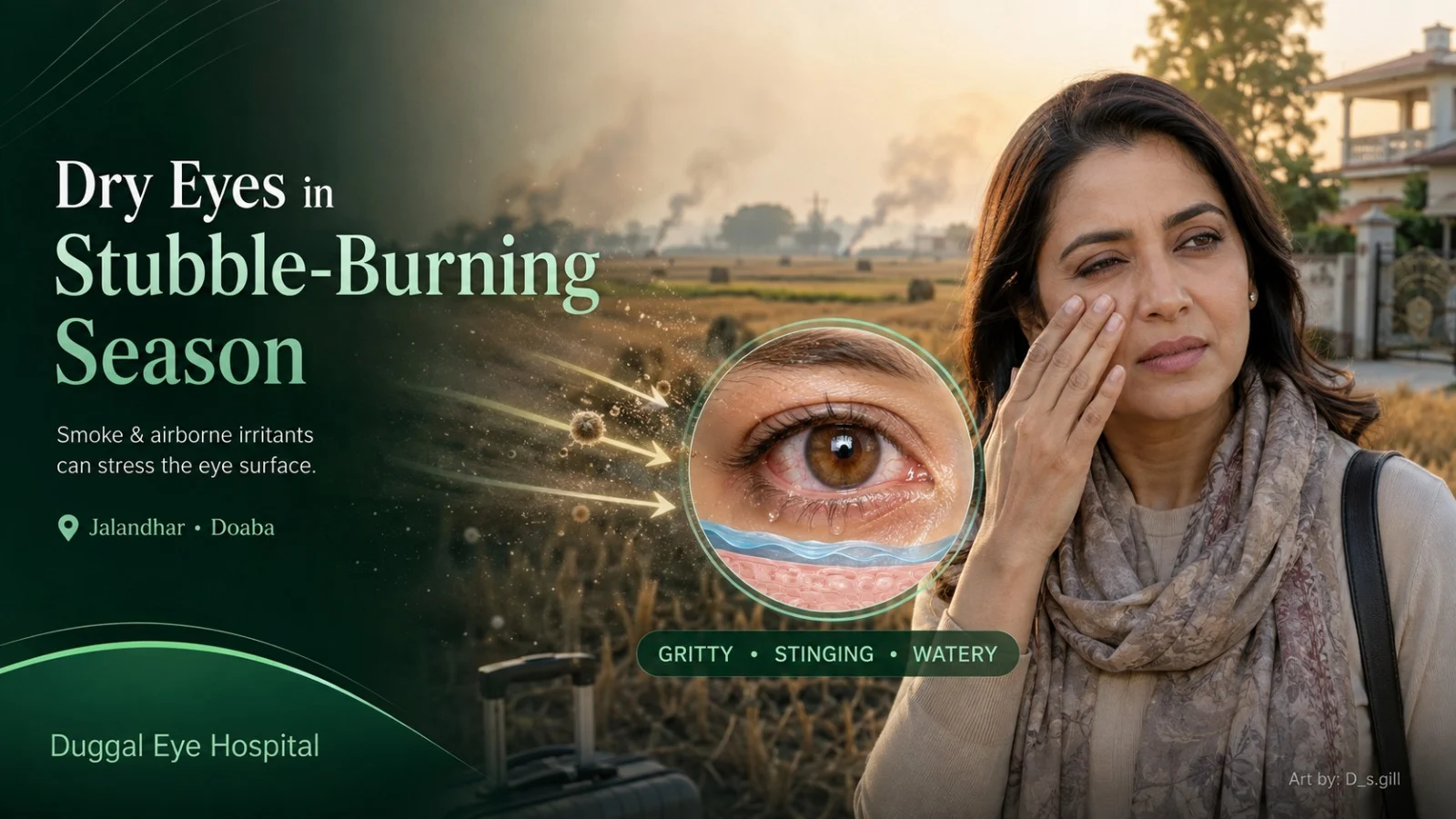
Simran left Jalandhar for Canada eight years ago and comes back every couple of years, usually timed around a wedding or Diwali. This trip, three days in, her eyes had started watering constantly on her evening walk near her parents’ house — gritty, stinging, worse by dusk. She assumed it was jet lag, or maybe the different air conditioning. Her mother, unbothered, just handed her eye drops from the kitchen cabinet without being asked. “It’s that time of year again,” she said, and went back to what she was doing.
Her mother wasn’t wrong, and she wasn’t being dismissive either — she’d simply lived through this particular season enough times to recognise it instantly. Every autumn, thousands of people across Doaba assume their eyes are just “tired” or “allergic” — when what’s actually happening is a measurable, physical irritant load settling directly on the ocular surface. Knowing the difference changes what actually helps.
This is the season when paddy stubble across Punjab’s fields gets burned to clear land for wheat sowing — a practice that reliably begins in mid-September and runs through November. Long-time residents adapt to it without quite noticing, the way you stop hearing a familiar noise. The people who feel it sharpest are often the ones coming back after time away, or the ones whose eyes were already sensitive to begin with. Either way, understanding what’s actually happening to the eye’s surface during this window is more useful than waiting for it to pass.
What's actually happening to your Eyes?
The eye’s surface is protected by a thin, continuously renewed tear film — a layered coating that keeps the surface smooth, clear, and resistant to irritation. Under normal conditions, this film is stable enough that you don’t think about it at all.
During stubble-burning season, fine particulate matter from crop-residue smoke, along with ordinary dust stirred up by drier autumn air, lands directly on this film. The particles physically disrupt its evenness, trigger an inflammatory response in the surface tissue, and speed up tear evaporation — all of which produces the classic seasonal complaint: eyes that feel gritty, burn by evening, water excessively, and never quite feel comfortable no matter how often you blink. Screen use or poor lighting alone doesn’t cause this, though both can make an already irritated ocular surface feel worse. It is a direct, physical response to what’s actually in the air.
Dry eye, allergy, or infection?telling them apart!
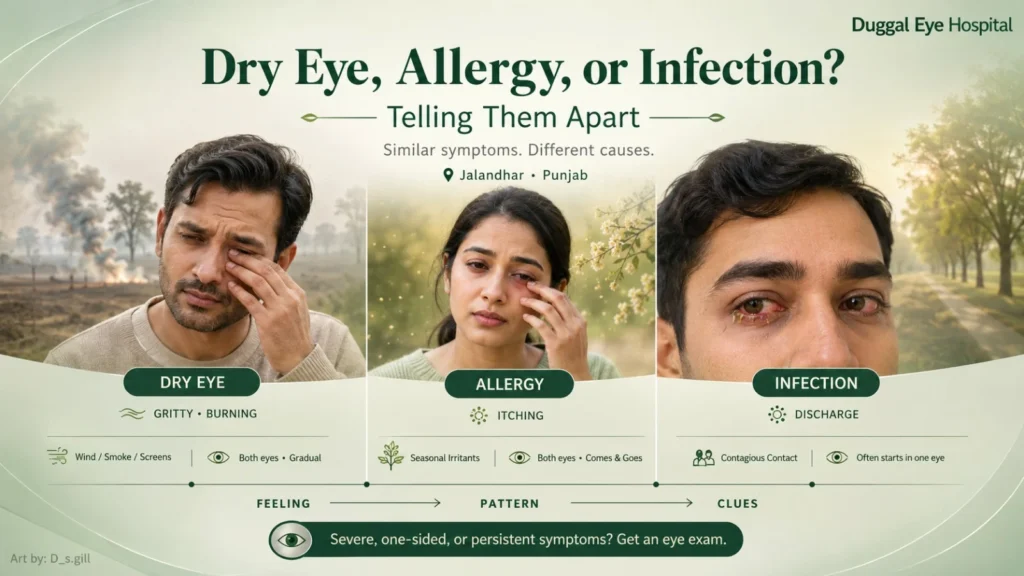
This is the most practically useful thing this article can offer, because all three conditions flare up in the same season, share overlapping symptoms, and need different responses.
| Irritant / Dry Eye | Allergic | Infective | |
|---|---|---|---|
| Dominant feeling | Gritty, burning | Itching | Discomfort with discharge |
| Discharge | Watery, not thick | Stringy, clear | Thick, sticky, coloured |
| Pattern | Both eyes, gradual | Both eyes, comes and goes | Often starts in one eye |
| Associated signs | Worse with wind, smoke, screens | Sneezing, runny nose | Crusting, especially on waking |
Mild versions of all three are common this season and often improve with simple self-care. The distinction matters most when symptoms are severe, one-sided, or not settling within a few days — at that point, guessing is less useful than an actual exam.
Why This Isn't “Just Dry Eyes” If Left Untreated
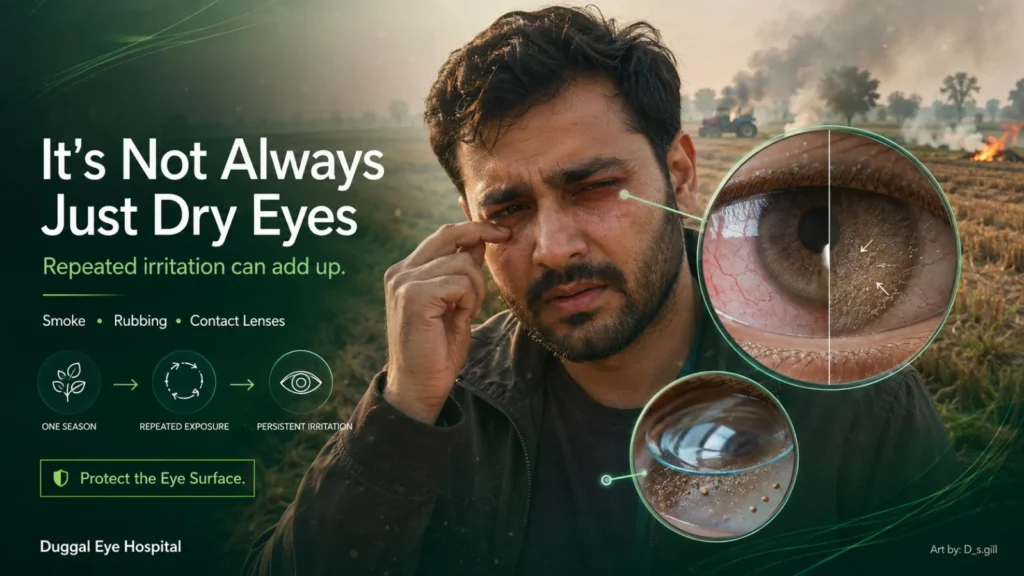
Treating seasonal irritation as a minor, self-limiting nuisance is usually fine — but not always, and it’s worth knowing why.
- Untreated ocular surface inflammation can become a chronic problem rather than a purely seasonal one, particularly with repeated exposure year after year.
- Pollution-related irritation can unmask or worsen pre-existing dry eye, blepharitis, or allergic eye disease that was previously mild enough to ignore.
- Rubbing — the instinctive response to itching or grit — is precisely what causes corneal micro-abrasion and makes symptoms worse, not better.
- Contact lens wearers face materially higher risk during this window, since particulate matter can get trapped between the lens and the eye’s surface.
Who's Most at Risk Across Jalandhar and Doaba
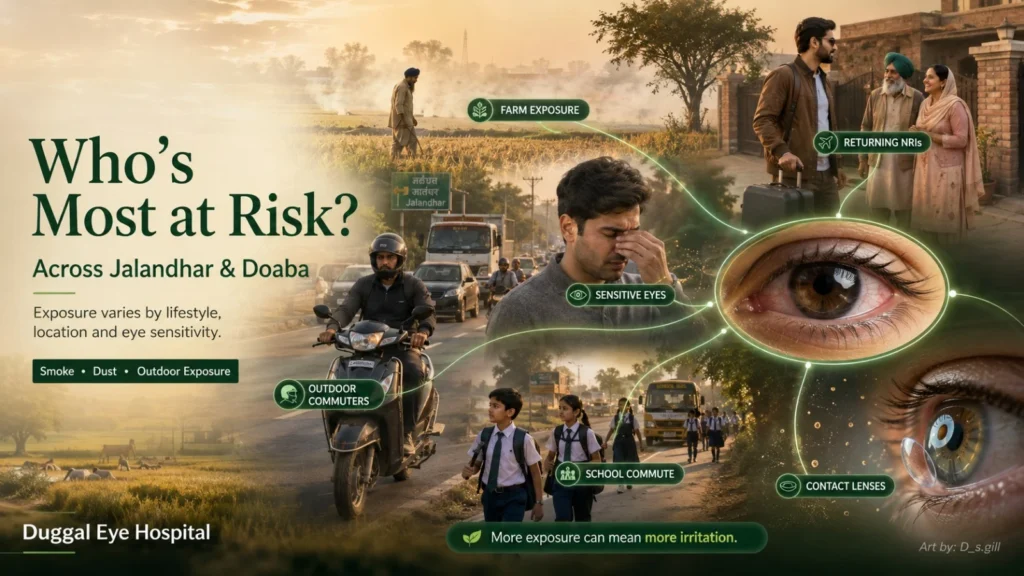
This is a predictable, recurring seasonal pattern — not a one-off event — and certain groups feel it more sharply than others.
Outdoor commuters and two-wheeler riders along Jalandhar’s outer roads and the GT Road corridor face the heaviest exposure during early-morning and evening burn windows, when particulate settling is at its worst. Agricultural workers and families in villages directly adjacent to burning fields have the most direct exposure of anyone in the region. NRIs and family returning for the wedding season or Diwali often feel it hardest precisely because their eyes haven’t had years to adapt. Patients with existing dry eye or allergic conjunctivitis experience this as an annual flare rather than a new problem. School-going children face long outdoor exposure during their commute and at recess. And contact lens wearers, across every other group, carry an added layer of risk on top of whichever category they already fall into.
What actually helps: protecting your eyes this season?
When to See a Doctor, Not Just Wait It Out
Most seasonal eye irritation is genuinely manageable with the self-care steps above. A smaller number of cases need an actual examination rather than more patience.
Pain, not irritation; light sensitivity; any change in vision; symptoms markedly worse in one eye than the other; symptoms that persist beyond a few days despite self-care; and any history of eye surgery or contact lens use combined with new symptoms all warrant prompt evaluation. Thick or coloured discharge, especially with crusting on waking, suggests an infective process that self-care alone won’t resolve.
A related concern: Diwali and firecracker exposure
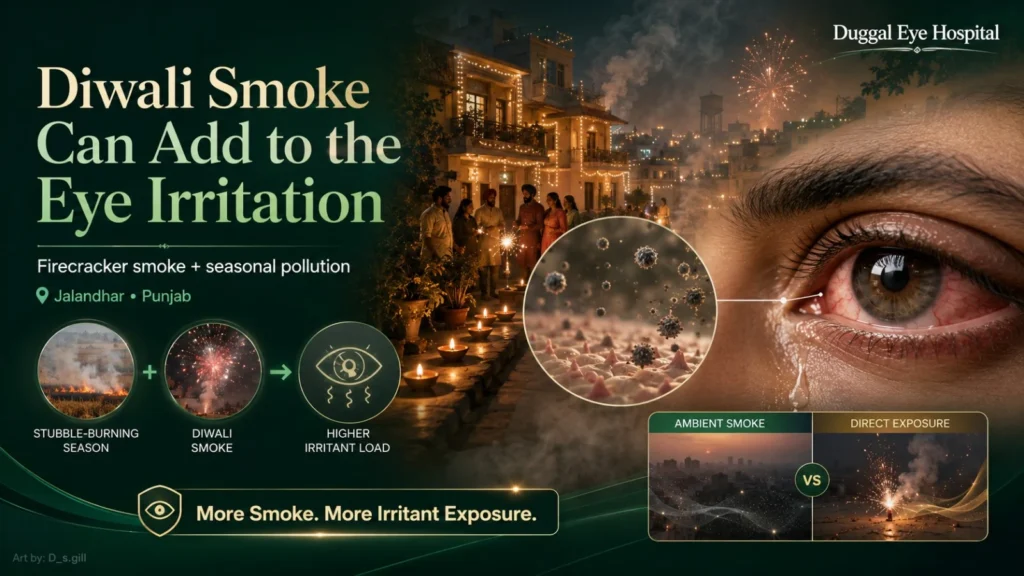
Diwali falls within this same pollution window most years, and firecracker smoke and chemical residue compound the same seasonal irritant load discussed throughout this article — sometimes acutely, in the case of direct chemical or thermal exposure to the eye. This deserves its own dedicated treatment rather than a brief mention here; a focused piece on firework eye safety will follow separately.
What to Expect at Duggal Eye Hospital Jalandhar ?
Duggal Eye Hospital, Jalandhar is an NABH-accredited super-specialty eye hospital, operational for over two decades, under the clinical leadership of Dr Sanjeev Duggal, MS Ophthalmology. For seasonal eye irritation, a visit typically involves a history of symptom onset and pattern, a straightforward eye examination to distinguish between irritant, allergic, and infective causes, and a clear discussion of next steps — whether that’s reinforced self-care, or treatment where an underlying condition is found. Patients travelling in from across Doaba — Hoshiarpur, Kapurthala, Phagwara, Nakodar, Adampur, Phillaur and Kartarpur — face the same seasonal exposure pattern described throughout this piece, and the same evaluation applies regardless of which town they’re travelling from.
Most seasonal eye irritation responds well to simple protective habits — but persistent or worsening symptoms deserve an actual look, not a guess.
Dry Eye vs. Allergic vs. Infective — Reference Table
| Irritant / Dry Eye | Allergic | Infective | |
|---|---|---|---|
| Dominant feeling | Gritty, burning | Itching | Discomfort with discharge |
| Discharge | Watery, not thick | Stringy, clear | Thick, sticky, coloured |
| Pattern | Both eyes, gradual | Both eyes, comes and goes | Often starts in one eye |
| Associated signs | Worse with wind, smoke, screens | Sneezing, runny nose | Crusting, especially on waking |
Frequently Asked Questions
Not fundamentally — stubble-burning season aggravates the same tear-film mechanisms as everyday dry eye, but the particulate load makes it more acute and more widespread for a defined period each year.
Indoor air purifiers can meaningfully reduce cumulative particulate exposure at home, particularly during peak outdoor burning hours, though they don’t eliminate exposure from time spent outdoors.
They can be, with extra care — shorter wear times, daily disposables where possible, and strict lens hygiene reduce the added risk particulate matter poses to lens wearers specifically.
Yes. School-going children with significant outdoor exposure during commute and recess are among the groups most affected, and the same protective steps apply to them.
It generally tracks the burning season itself — building from mid-September, peaking through October into November, and easing as the season ends — though individual symptom duration varies.
No. Redness is a common feature of irritant and allergic reactions as well as infection. Discharge type, whether one or both eyes are affected, and associated symptoms help distinguish between them.
Steroid drops may be appropriate for certain inflammatory presentations, but they require a proper diagnosis and prescription — they are not a self-care option and inappropriate use can cause serious harm.
Yes. Particulate-driven irritation can affect eyes with no prior history of dry eye or allergy, particularly in people whose eyes aren’t accustomed to the seasonal air quality, such as returning visitors.
Well-fitted wraparound sunglasses that reduce airflow and particulate contact around the eyes are a reasonable protective measure for most people; they don’t need to be medical-grade to be useful.
Yes — reinforcing usual lubricating drop use proactively, rather than waiting for a flare, and being more cautious about outdoor exposure timing, generally helps existing dry eye patients get through this season more comfortably.