
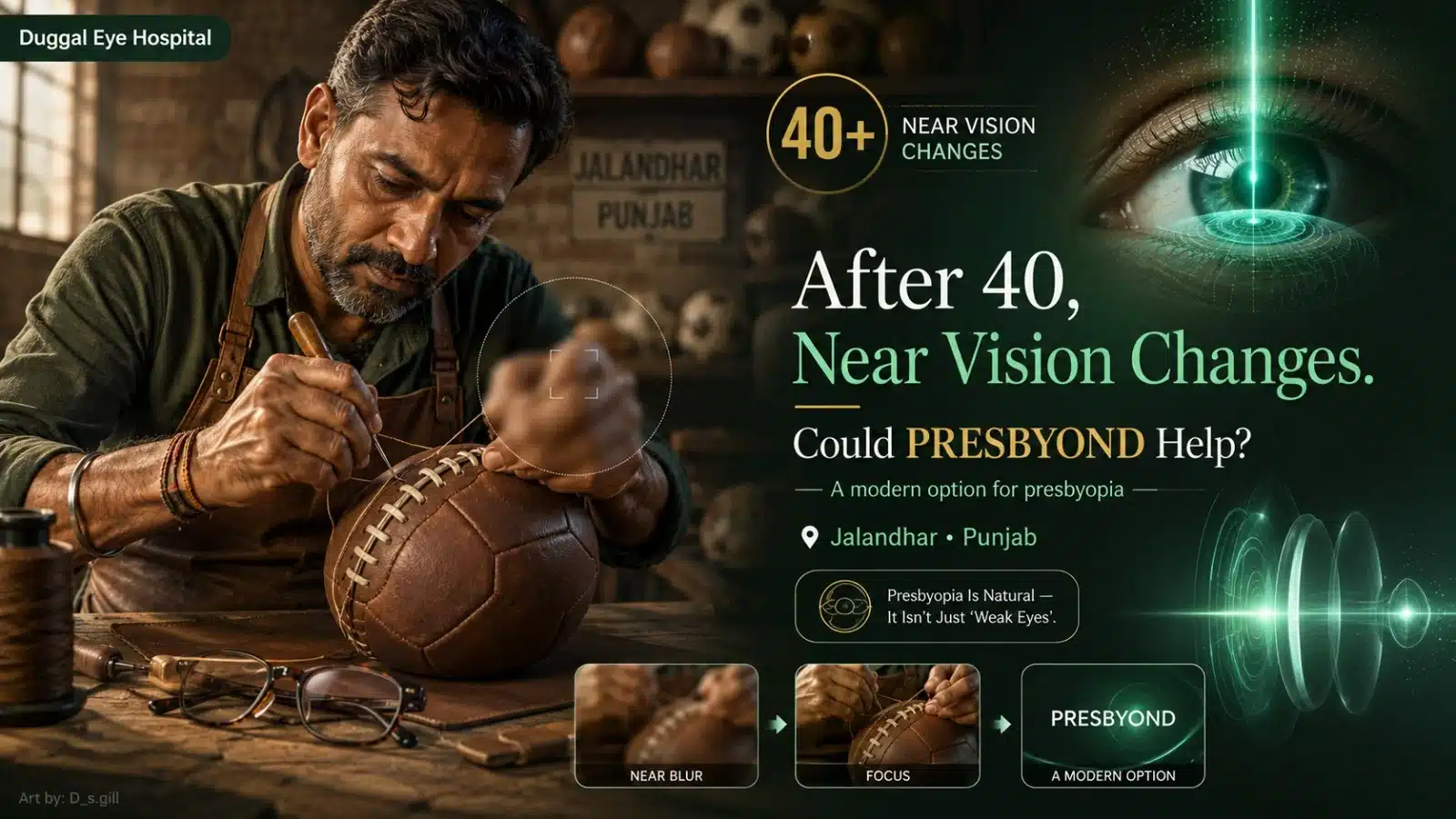
In a workshop off Sports Colony Road, on the Jalandhar city periphery, a craftsman in his late forties hand-laces the seam of a leather football, the same stitch pattern he has repeated tens of thousands of times since he first picked up an awl as a teenager. He has never needed glasses for anything — not for reading a newspaper, not for watching a Kabaddi match from the back row. But over the last year or two, he has started holding the ball a little further from his face to line up each stitch, and pausing more often to blink the seam back into focus. He assumed it was tiredness. It wasn’t tiredness. It was his eyes quietly entering a new stage they were always going to reach.
This isn’t his glasses getting weaker — he never wore any. It’s the eye’s own natural lens losing a specific ability it had for roughly forty years without him ever noticing it was working. For a trade built entirely on fine, close-range precision, that loss isn’t a minor inconvenience. It’s a direct threat to a livelihood.
The medical name for what’s happening to him is presbyopia, and it arrives for almost everyone somewhere in the early-to-mid forties, regardless of whether a person has ever needed corrective vision before in their life. It is not a disease, and it is not a sign of anything going wrong with the eye as a whole. It is also, critically, a completely different problem from the short-sightedness or astigmatism that LASIK was originally designed to correct — which is why plenty of people who’ve had LASIK years earlier still, quite normally, find themselves reaching for reading glasses in their forties.
What Is PRESBYOND® Laser Blended Vision?
PRESBYOND® Laser Blended Vision is a laser vision correction strategy, developed by ZEISS, built specifically to give presbyopic patients a workable range of vision across distance, intermediate and near — without needing reading glasses for most everyday tasks. Introduced in 2009 and now performed globally, it is delivered on ZEISS’s excimer laser platforms using dedicated treatment-planning software that calculates an individualised ablation profile for each eye.
The core idea: the two eyes are given deliberately different, coordinated refractive targets. The dominant eye is corrected close to plano, essentially for distance. The non-dominant eye is corrected to be mildly myopic — typically up to around -1.50 dioptres — biasing it toward near vision. That difference alone is an old technique called monovision. Presbyond takes it a step further.
Where Presbyond Actually Diverges From Plain Monovision
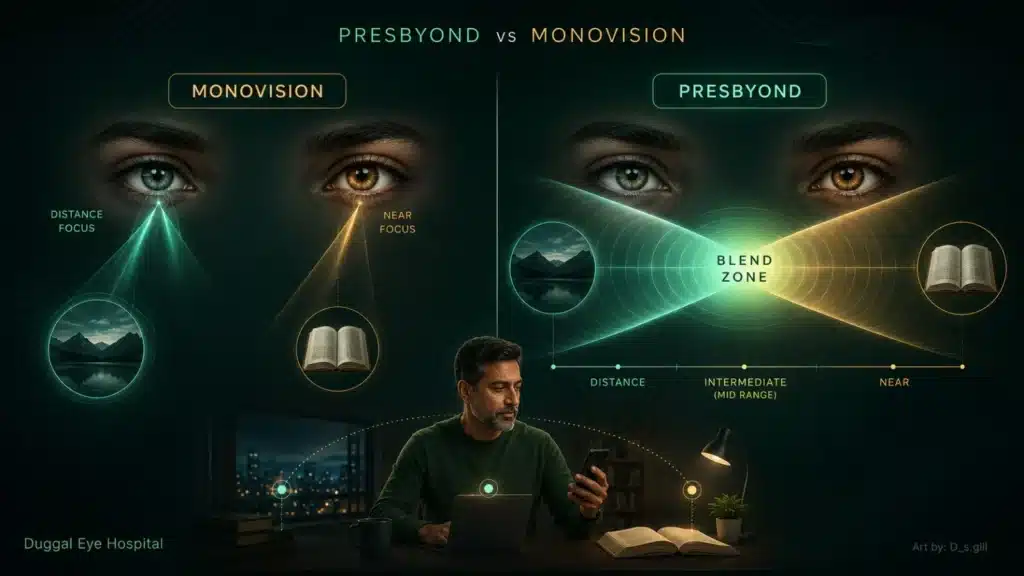
Presbyond vs. Conventional Monovision
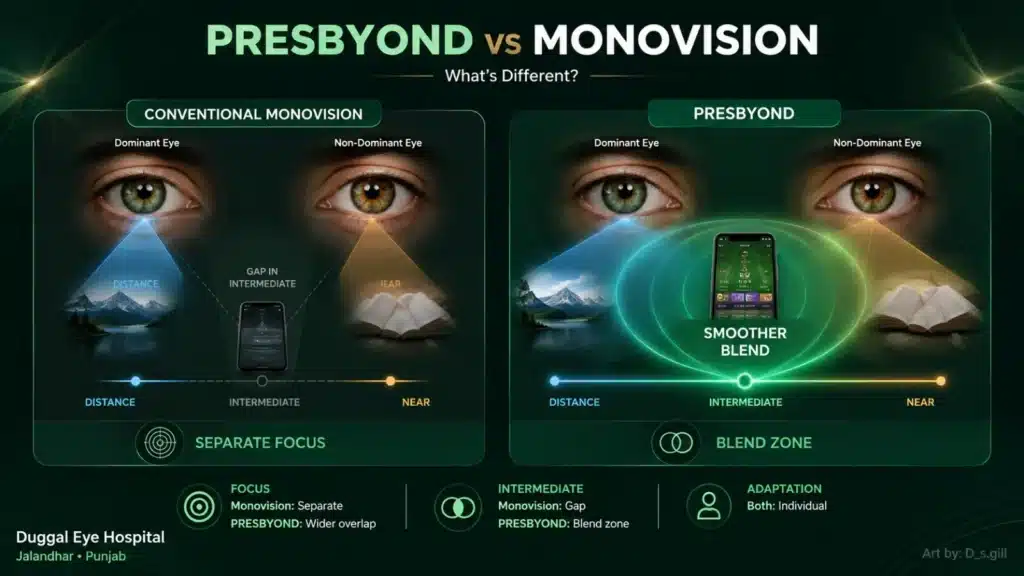
Because Presbyond is built on a monovision foundation, the two get confused constantly. The practical difference shows up most clearly at intermediate range — arm’s-length distance, where a phone, a scorecard, or a stitching template typically sits.
| Feature | Conventional Monovision | PRESBYOND Laser Blended Vision |
|---|---|---|
| Basic strategy | Different distance targets between the two eyes | Micro-monovision plus widened depth of focus in each eye |
| Dominant eye | Usually set for distance | Distance-biased, near-plano |
| Non-dominant eye | Set for near, often more myopic | Near/intermediate-biased, typically up to -1.50D |
| Transition between zones | Often an abrupt, noticeable gap | Designed to create a smoother blend zone |
| Binocular vision quality | Can be reduced in some patients | Designed to better preserve binocular summation and stereopsis |
| Patient adaptation | Variable, patient-dependent | Variable, patient-dependent |
| Suitability | Assessed individually | Assessed individually |
Neither approach is universally superior. Individual patient selection, ocular dominance, and how comfortably a patient’s brain adapts to receiving two different images from two eyes genuinely affect the outcome either way—Presbyond narrows the intermediate gap for many patients, but that doesn’t remove the need for careful candidate selection.
Can Presbyond Really End Your Dependence on Reading Glasses?
This is the real question underneath every other question a patient asks, even when it’s phrased differently. The honest answer has more texture than a straight yes.
Distance vision tends to be the most reliably sharp outcome, since the dominant eye sits close to plano. Intermediate vision — phones, laptops, dashboards, a stitching frame held at arm’s length — is where the blend zone does its most valuable work, and where many patients notice the biggest everyday difference. Near vision for ordinary print in decent light is usually very workable without glasses for most patients. Where honesty matters most is at the edges: very fine print, dim workshop lighting, and long stretches of close-up work can still be more comfortable with low-strength reading glasses for some patients, and the eye keeps ageing after treatment, which can shift the balance gradually over years.
Who Is a Good Candidate for Presbyond?
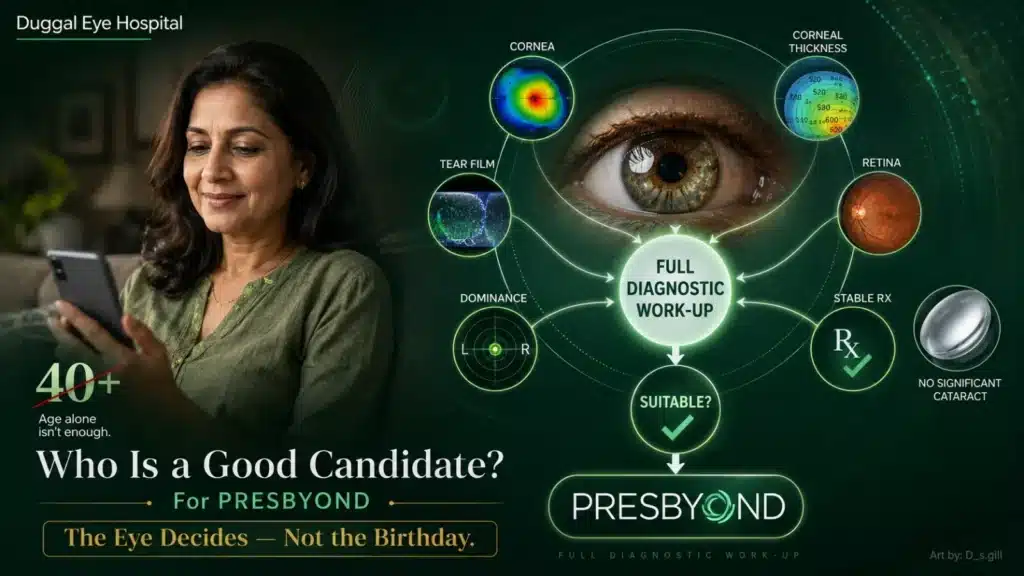
Candidacy rests on a combination of findings evaluated together, not any single one alone: presbyopic status and age, stability of refraction, corneal health and thickness, corneal topography and tomography findings, ocular surface and tear-film health, retinal health, the absence of a visually significant cataract, clearly established ocular dominance, and expectations that match what the treatment can realistically deliver.
Presbyond is not offered because someone has turned 40. It is offered because a specific eye, after a full diagnostic work-up, is judged suitable for this specific strategy.
Who May Need to Consider an Alternative?
Certain findings call for further assessment rather than an automatic no: significant corneal disease, unstable or still-changing refraction, meaningful ocular surface disease, a visually significant cataract already present, significant retinal disease, or expectations that don’t line up with what laser blended vision can realistically achieve. None of this is a rigid, blanket exclusion list — it is exactly what the work-up exists to catch, so an honest conversation about alternatives can happen before surgery, not after.
Precision Trades and Presbyopia: Why Jalandhar Feels This Differently
Jalandhar’s economy runs on close-range hand precision in a way few Indian cities can claim. The city and its surrounding belt manufacture sporting goods for international markets — footballs, cricket bats and gloves, boxing equipment — alongside a long-standing hosiery and knitwear industry built on fine needlework. For a workforce whose livelihood depends on threading a needle, aligning a stitch, or reading a fine gauge marking at arm’s length, presbyopia isn’t background noise. It shows up directly in output, in error rates, in how long a working day feels.
This is also a city with an unusually large NRI footprint — families with members across Canada, the UK and beyond, many of whom return periodically and compare notes on what’s medically available at home versus abroad. Presbyond is not a treatment Jalandhar patients need to travel overseas to access; it is available locally, evaluated with the same diagnostic rigour as anywhere else.
Presbyond vs. LASIK, SMILE and Other Laser Procedures
Standard LASIK and lenticule-based procedures such as SMILE correct a fixed refractive error — short-sightedness, long-sightedness, astigmatism — at a single focal distance, almost always optimised for distance vision in both eyes. Neither is designed to address presbyopia, and a patient who has had either procedure can still develop presbyopia later, exactly as someone who never needed glasses at all can. Presbyond is a distinct strategy layered specifically around the presbyopia problem, using coordinated, asymmetric targets between the two eyes rather than matching targets in both.
Presbyond vs. RLE and Multifocal/EDOF Lenses
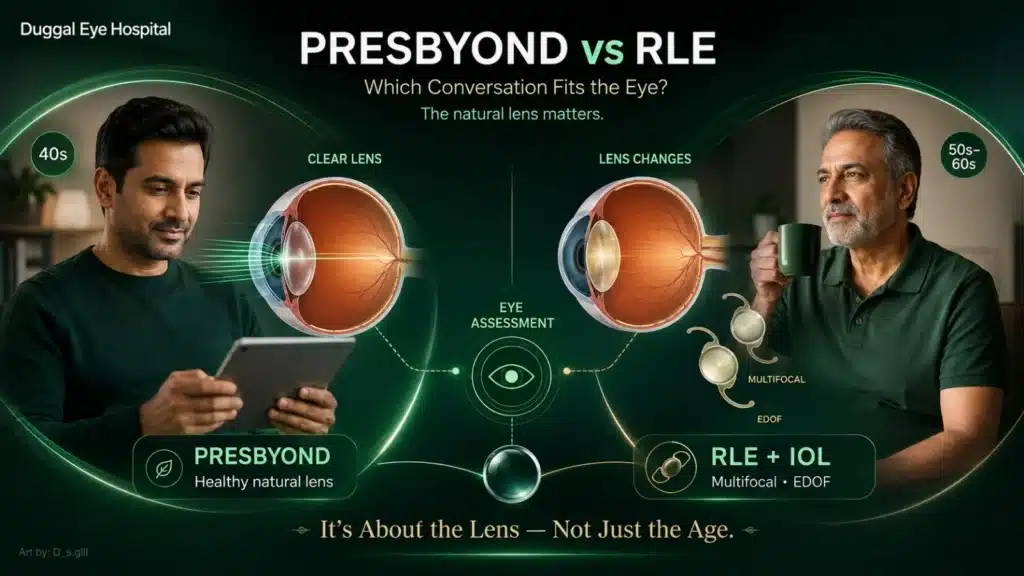
For patients whose natural lens has already begun changing — or who are simply older, where such changes become more likely — the more relevant comparison often shifts from Presbyond to refractive lens exchange (RLE), where the natural crystalline lens is replaced with an intraocular lens, which may be monofocal, multifocal, or extended depth of focus (EDOF) in design.
A patient in their early-to-mid forties with a healthy, clear natural lens typically faces a different conversation than a patient in their late fifties or sixties, where early lens changes are more likely to already be present. Neither approach is universally recommended; the right conversation depends on the lens findings, not age alone.
What Happens Before Presbyond Surgery?
A properly conducted Presbyond evaluation is a genuinely thorough process, not a formality on the way to a booking.
The work-up runs through history-taking, refraction, ocular dominance testing, corneal topography and tomography, pachymetry, and ocular surface assessment, followed by pupil and visual-quality assessment where relevant, a lens examination, a retinal examination, a suitability assessment, and a direct, unhurried conversation about visual expectations before any treatment plan is finalised.
What Is Recovery and Adaptation Actually Like?
Before surgery, expect a consultation covering the measurements above, counselling on realistic outcomes, informed consent, and a personalised treatment plan built from your own eyes’ data. The procedure itself is an outpatient laser treatment, typically taking a few minutes per eye. Immediately afterward, some visual fluctuation is normal, alongside the general recovery pattern expected after laser corneal surgery, with follow-up visits scheduled to track healing. In the weeks that follow, neuroadaptation — the brain learning to fuse the two differing images into one comfortable, functional range — continues to settle, and its pace genuinely varies from patient to patient; it cannot be guaranteed on a fixed timeline.
Why Patients from Across Doaba Choose Duggal Eye Hospital
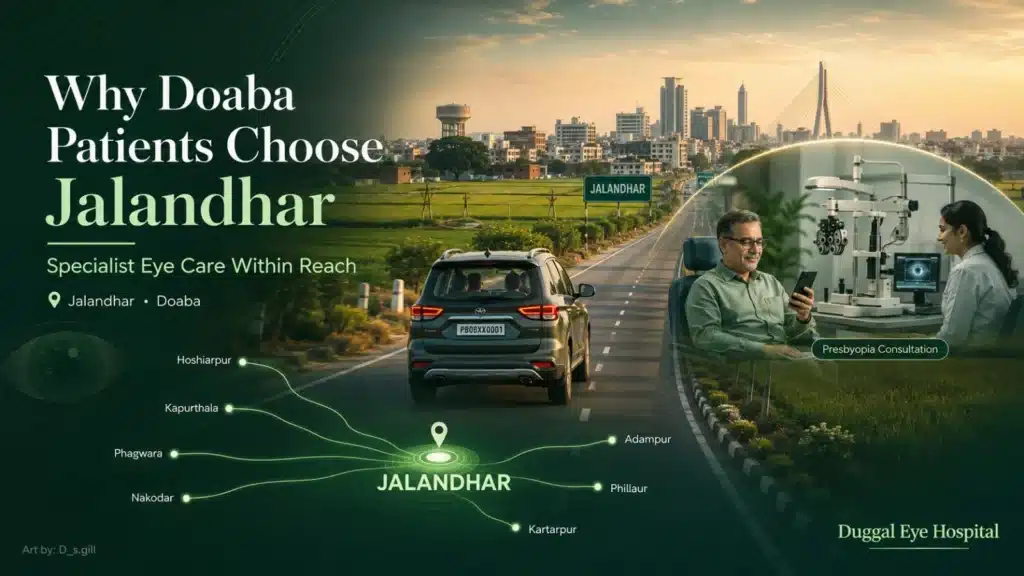
Jalandhar sits at the centre of the Doaba region, within practical reach of Hoshiarpur, Kapurthala, Phagwara, Nakodar, Adampur, Phillaur and Kartarpur. For many patients across this belt, the road connecting these towns to Jalandhar is one they already travel for work, family, and the sports-goods and hosiery trade itself—making a properly evaluated presbyopia consultation a genuinely reachable option, not a special trip.
Is Presbyond the Right Next Step for You?
If reading glasses have gone from an occasional annoyance to a daily interruption — in a workshop, at a desk, or anywhere fine, close-range focus matters — Presbyond is a reasonable question to bring to a consultation, not a decision to make from an article. The only way to know whether your own eyes qualify is the diagnostic work-up described above.
The first step is not booking surgery. It is finding out whether your eyes are suitable.
Presbyond vs. Conventional Monovision — Reference Table
| Feature | Conventional Monovision | PRESBYOND Laser Blended Vision |
|---|---|---|
| Basic strategy | Different distance targets between the two eyes | Micro-monovision plus widened depth of focus in each eye |
| Dominant eye | Usually set for distance | Distance-biased, near-plano |
| Non-dominant eye | Set for near, often more myopic | Near/intermediate-biased, typically up to -1.50D |
| Transition between zones | Often an abrupt, noticeable gap | Designed to create a smoother blend zone |
| Binocular vision quality | Can be reduced in some patients | Designed to better preserve binocular summation and stereopsis |
| Patient adaptation | Variable, patient-dependent | Variable, patient-dependent |
| Suitability | Assessed individually | Assessed individually |
Frequently Asked Questions
Presbyond is generally relevant once presbyopia has developed, typically from the early-to-mid forties onward, and is most commonly considered for patients roughly in the 40–60 age range. Suitability is determined by eye findings, not age alone.
The procedure itself is generally well-tolerated, similar in experience to standard LASIK, using numbing eye drops. Some temporary discomfort or sensitivity during early recovery is normal.
Initial visual recovery generally follows a similar pattern to standard laser corneal surgery, with follow-up visits scheduled to track healing. Full neuroadaptation to the blended vision effect varies by patient and is not on a fixed timeline.
Many patients achieve significant independence from reading glasses for most daily tasks, but Presbyond does not guarantee complete, permanent spectacle independence in every situation — fine print or dim lighting may still call for glasses occasionally for some patients.
Some patients notice changes in night-vision quality, such as glare or halos, particularly during the adaptation period. This should be discussed individually as part of the pre-treatment consultation.
Dry eye is a recognised consideration after any laser corneal procedure and is assessed as part of the pre-operative work-up. Pre-existing ocular surface issues are evaluated before treatment planning for this reason.
Conventional monovision relies only on a difference in target between the two eyes, which can leave an abrupt gap in intermediate vision. Presbyond adds a widened depth of focus to each eye individually, designed to create a smoother blend zone rather than a hard switch.
Cataract surgery remains available later if needed, and prior Presbyond treatment is a relevant factor your surgeon will account for when planning cataract surgery and intraocular lens selection at that time.
The corneal correction itself is permanent, but the eye continues to age naturally afterward, which can gradually shift near-vision comfort over years, similar to ongoing age-related change in any eye.
Cost depends on diagnostic findings, treatment planning, and the specific technology used. The first step is a consultation to determine suitability, after which a personalised plan and cost estimate can be discussed.
Standard LASIK corrects a fixed refractive error at a single focal distance, usually optimised for distance vision in both eyes. It does not address presbyopia, which is why someone who has already had LASIK can still develop presbyopia later and separately consider Presbyond.
A thorough second opinion should review your own corneal topography and tomography, ocular dominance testing, tear-film and ocular surface status, lens and retinal findings, and a clear, individual explanation of what range of vision is realistically achievable for your specific eyes.