
Duggal Eye Hospital

Eye Flu in Monsoon: Symptoms, Quick Relief & Prevention

The first showers after a long, dusty Punjab summer feel like a gift. Within days of that gift arriving, though, our OPD at Duggal Eye Hospital starts filling up with a very familiar complaint: red, watery, gritty eyes. Ask around in any mohalla in Jalandhar right now — Model Town, Guru Nanak Pura, Urban Estate, or the lanes near Ghanta Ghar — and you’ll find at least one household already dealing with it. Eye flu is back, and it has arrived right on schedule with the monsoon.

We wrote about eye flu on this blog before, and that article struck a chord with a lot of readers across the Doaba belt. This time, we wanted to go further — not just explain what eye flu is, but actually hand you a plan. What to do the moment you feel that first itch. What genuinely brings relief at home. What to avoid, no matter what your neighbour or WhatsApp forward tells you. And exactly when it’s time to stop waiting and walk into a clinic.

“Every monsoon, I see the same pattern,” says Dr. Sanjeev Duggal, Chief Eye Specialist at Duggal Eye Hospital. “A patient waits three or four days, tries something a relative suggested, and only comes in once the eye is swollen shut. Eye flu is rarely dangerous if it’s managed early and correctly. The trouble starts when people either panic and self-medicate with the wrong drops, or ignore it for too long.”

What Exactly Is Eye Flu?

“Eye flu” is the everyday Punjabi-English term for conjunctivitis — inflammation of the conjunctiva, the thin, clear membrane that covers the white of your eye and lines the inside of your eyelid. When this membrane gets infected or irritated, the tiny blood vessels in it swell up, and the eye turns pink or red — which is why it’s also called pink eye.
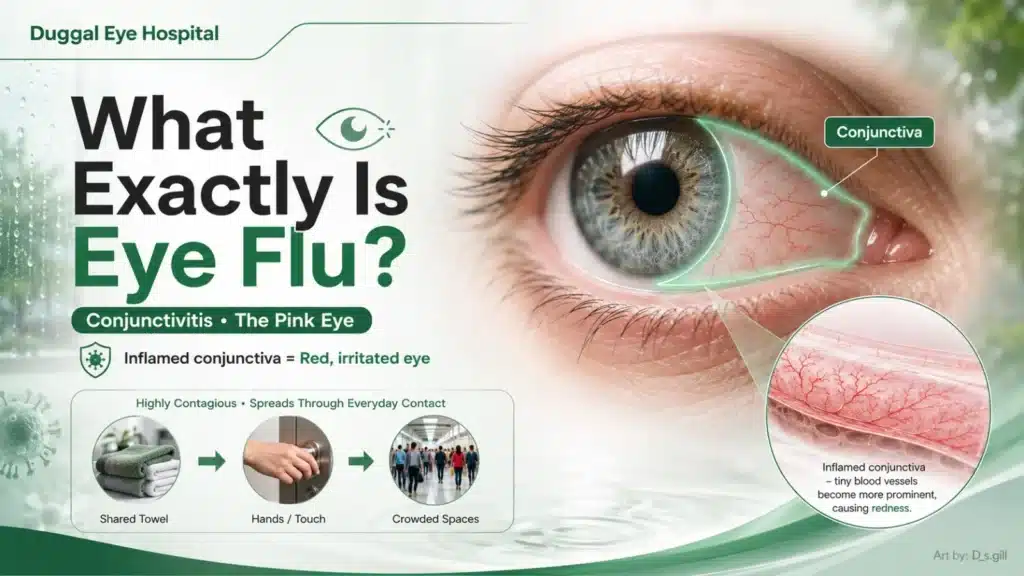
Monsoon conjunctivitis in North India is almost always viral, spreading through adenoviruses that thrive in humid, waterlogged conditions. It is highly contagious — a shared towel, a doorknob, a handshake, or even the air in a crowded classroom or bus is enough to pass it on. That’s exactly why it moves through entire families, schools, and offices in Jalandhar within days of the first case showing up.

Why Punjab's Monsoon Makes This Worse

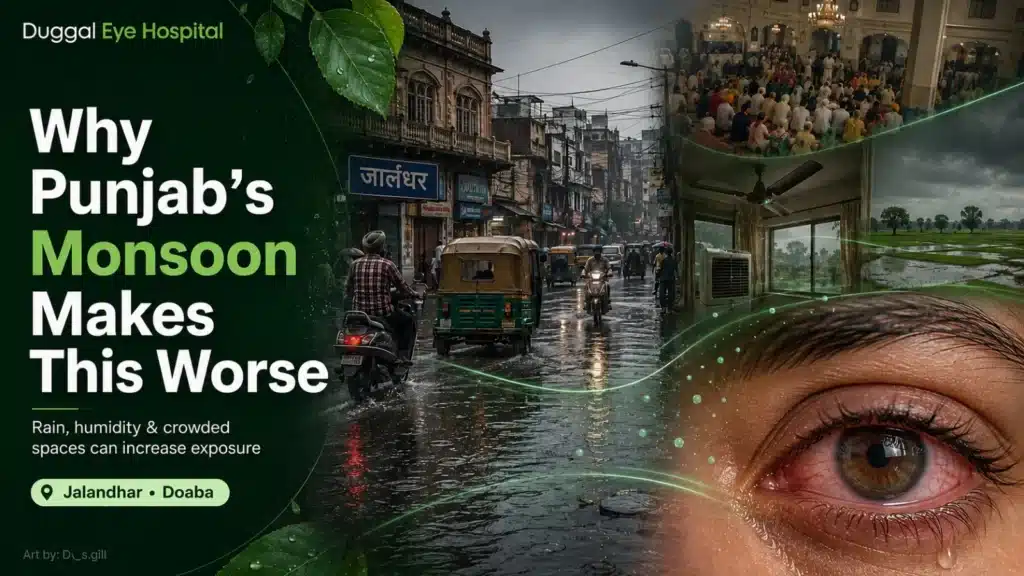
Jalandhar and the surrounding Doaba region — Kapurthala, Nakodar, Phillaur, Nawanshahr — see a very particular kind of monsoon: intense bursts of rain, followed by waterlogged streets, open drains overflowing, and a level of humidity that simply doesn’t let surfaces dry out. A few local factors make eye flu spread faster here than people expect:

  • Waterlogged bazaars and narrow streets in the older parts of the city mean more contact with contaminated puddle water splashed up by two-wheelers and rickshaws.
  • Shared spaces — gurdwaras, schools, tuition centres, wedding halls (this is peak shaadi season too) — bring large numbers of people together indoors, right when the virus is most active.
  • Ceiling fans and coolers running non-stop in the humid heat keep dust and airborne particles circulating.
  • Field and farm exposure in the villages around Jalandhar, where standing water in the fields is unavoidable during work hours.
None of this means you’re helpless against it. It simply means prevention has to be a little more deliberate here than the standard advice you’ll find on generic health websites.

Symptoms: How to Tell It's Eye Flu and Not Just Tiredness

Eye flu usually starts in one eye and moves to the other within a day or two. Watch for:

  • Redness or a pink tinge in the white of the eye
  • Watery discharge, or a thicker yellow-green discharge if a bacterial infection sets in alongside it
  • A gritty, “sand in the eye” feeling
  • Swollen, puffy eyelids, especially on waking up
  • Eyelashes crusted or stuck together in the morning
  • Mild sensitivity to light
  • Occasional blurring of vision that clears once the discharge is wiped away
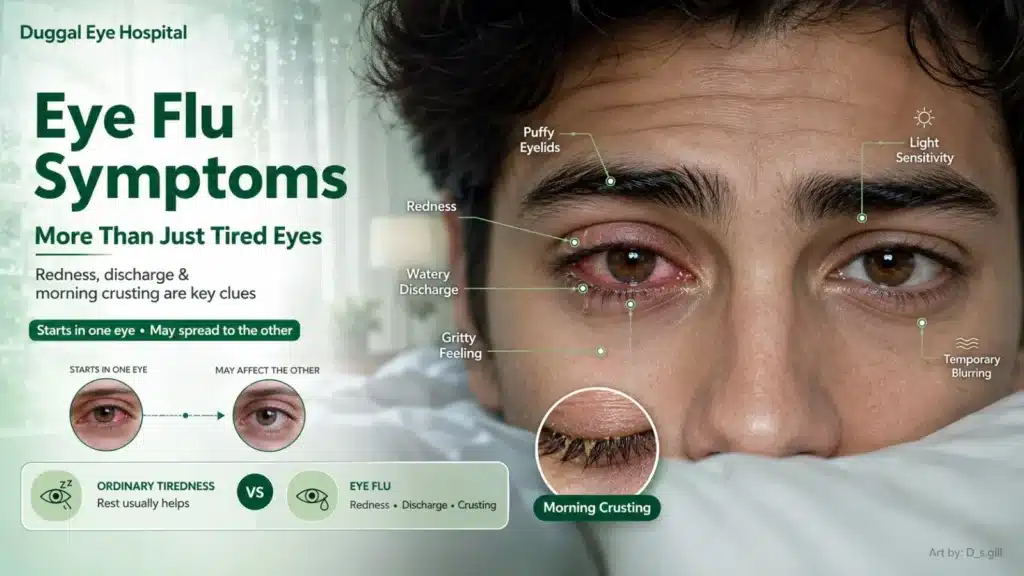
“A useful rule of thumb I give my patients,” Dr. Duggal notes, “is that ordinary eye strain or tiredness doesn’t come with morning crusting or a thick discharge. If you’re waking up with your eyelids stuck together, that’s your sign it’s an infection, not just fatigue.”

Quick Relief: What Actually Helps in the First 24–48 Hours

This is the part most eye flu articles skip — what to genuinely do the moment symptoms show up, before you can get to a clinic.

  1. Cold compress, not warm, for viral eye flu. A clean cloth dipped in cool (not icy) water and gently pressed on closed eyelids for 10 minutes, a few times a day, reduces swelling and soothes irritation almost instantly. (A warm compress is more suited to a stye — see below — so it’s worth knowing the difference.)
  2. Preservative-free lubricating eye drops (“artificial tears,” available over the counter at any Jalandhar pharmacy) rinse out irritants and ease the gritty feeling. These are safe to use frequently and don’t need a prescription.
  3. Wipe discharge outward, not inward — use a fresh cotton pad for each eye, wiping from the inner corner outward, and discard it immediately. Reusing the same pad on both eyes is one of the most common ways people infect their second eye.
  4. Remove contact lenses immediately and switch to spectacles until the infection has fully cleared and your eye specialist gives the go-ahead.
  5. Resist the urge to rub. It’s the single hardest instruction to follow and the single most effective one.

“Patients often ask me for ‘the strongest drop available’ the moment they walk in,” says Dr. Duggal. “But strong isn’t always right. Steroid combination drops can actually worsen a viral infection if used without supervision. That’s the one home-remedy myth I’d really like Jalandhar families to unlearn this monsoon.”

Prevention: Simple Habits That Actually Hold Up in Punjab's Monsoon

  • Wash hands properly and often — plain soap, 20 seconds, especially after using public transport, touching money, or coming in from the rain.
  • Keep a separate towel and pillow cover for anyone in the house who already has symptoms, and wash these daily in hot water.
  • Carry a small bottle of hand sanitiser if you’re commuting through waterlogged areas of the city — it’s a small habit that pays off during outbreak weeks.
  • Skip the eye makeup during an active outbreak, and never share kajal, eyeliner, or mascara at any time.
  • Keep children home from school for the first few contagious days if they show symptoms — most schools in Jalandhar already advise this, and it genuinely slows the spread through a classroom.
  • Avoid swimming pools and crowded religious gatherings during a known local outbreak, since chlorinated or communal water doesn’t fully eliminate the virus.
  • Don’t share spectacles, sunglasses, or phones face-down on shared surfaces during flu season — small habit, often overlooked.

Stye and Keratitis: The Other Monsoon Eye Troubles

Eye flu gets most of the attention, but two other conditions tend to rise alongside it every monsoon. Here’s how to tell them apart at a glance:

When to Stop Waiting and See an Eye Specialist

Home care resolves most viral eye flu cases within five to seven days. But Dr. Duggal advises coming in without delay if you notice:

  • Pain that goes beyond mild irritation
  • Any change in vision, even temporary blurring that doesn’t clear
  • Thick yellow or green discharge that keeps returning through the day
  • Symptoms lasting beyond a week with no improvement
  • Involvement of the cornea, light sensitivity that’s more than mild, or swelling that’s spreading beyond the eyelid

“There’s no reason to be a hero about this,” he adds. “A five-minute check can tell us whether it’s a straightforward viral case or something that needs a targeted medication. Waiting too long is the only real mistake people make.”

A Quick Word on Home Remedies Circulating Online

Every monsoon, a fresh batch of home remedies does the rounds on social media — rose water, breast milk, turmeric water, and similar suggestions.

Dr. Duggal is direct about this: “None of these have any medical basis for treating conjunctivitis, and some can actually introduce new contamination into an already inflamed eye. Cool compresses and proper hygiene remain the only home measures worth trusting.”

The Takeaway for Jalandhar Families This Season

Eye flu is uncomfortable, highly contagious, and, for the vast majority of people, entirely manageable without complications — provided it’s caught early and handled sensibly. Keep your hands clean, your towels separate, your eyes untouched, and your compress cool. And if things don’t settle within a few days, don’t wait it out — a quick visit to a qualified eye specialist is worth far more peace of mind than a WhatsApp remedy.

Duggal Eye Hospital’s team, led by Dr. Sanjeev Duggal, continues to see and treat monsoon eye infections through the season across Jalandhar and the wider Doaba region. If your symptoms aren’t easing up, walk in for a proper check rather than waiting it out.

Frequently Asked Questions

Yes. “Eye flu” is the common term used for conjunctivitis, an inflammation of the membrane covering the white of the eye and inner eyelid.

Most viral cases clear up within five to seven days with basic home care. If it lasts longer, a check-up is advisable.

No — this is a myth. Eye flu spreads through direct or indirect contact with infected discharge, not through eye contact or “looking” at an infected person.

A cool compress is better for viral eye flu, as it reduces swelling and soothes irritation. A warm compress is more suited to a stye.

It’s best to stay home for the first few contagious days, since eye flu spreads quickly in shared spaces like offices, classrooms, and public transport.

Preservative-free lubricating drops (artificial tears) are safe for home use. Antibiotic or steroid-combination drops should only be used if an eye specialist prescribes them, since the wrong drop can worsen a viral infection.

During monsoon, it’s almost always viral, typically an adenovirus. A smaller share of cases are bacterial, which usually show thicker yellow-green discharge and may need antibiotic drops.

Yes, it often starts in one eye and spreads to the second within a day or two, which is why hygiene steps like using a fresh cotton pad per eye matter so much.

It’s usually mild in children too, but their eyes should still be checked, since kids are more likely to rub their eyes and prolong or spread the infection at school.

Most lubricating drops are safe, but any prescription medication during pregnancy should be confirmed with both your eye specialist and gynecologist first.

Straightforward viral conjunctivitis does not usually affect vision permanently. Vision-threatening complications are rare and mainly linked to untreated corneal involvement (keratitis), which is why persistent blurring needs prompt attention.

Yes, sunglasses help with light sensitivity and also reduce the temptation to touch or rub the eyes, though they don’t replace the need to pause eye makeup during an active infection.

Yes, sunglasses help with light sensitivity and also reduce the temptation to touch or rub the eyes, though they don’t replace the need to pause eye makeup during an active infection.

Humidity keeps surfaces and hands damp for longer, waterlogging brings more contaminated splash-back, and crowded indoor gatherings during the rains all combine to spread the virus faster than in drier months.

Cases typically rise through July and August alongside the heaviest monsoon spells, and taper off as humidity drops going into autumn.

Yes — any eye makeup or applicator used while infected should be discarded, since it can harbour the virus and cause reinfection even after your eyes have healed.

Leave a Comment