
There is a particular kind of morning familiar to almost everyone who wears spectacles. The alarm goes off, the room is a blur, and the first task of the day — before brushing your teeth, before checking your phone — is finding your glasses. For a college student in Hoshiarpur cycling to class, a young software professional in Jalandhar rushing to a video call, or a business owner in Kapurthala inspecting stock before the shop opens, this small daily negotiation with blurred vision rarely feels urgent. It just feels normal. Until, one day, it doesn’t.
Maybe it is a wedding season where contact lenses dry out under the lights of a Doaba banquet hall. Maybe it is a father in Phagwara who wants to play badminton with his son without his spectacles sliding down his nose. Maybe it is an NRI, back in Jalandhar for a family visit, who has heard about laser vision correction abroad and wonders, almost as an afterthought, whether the same technology exists here at home. It usually does.
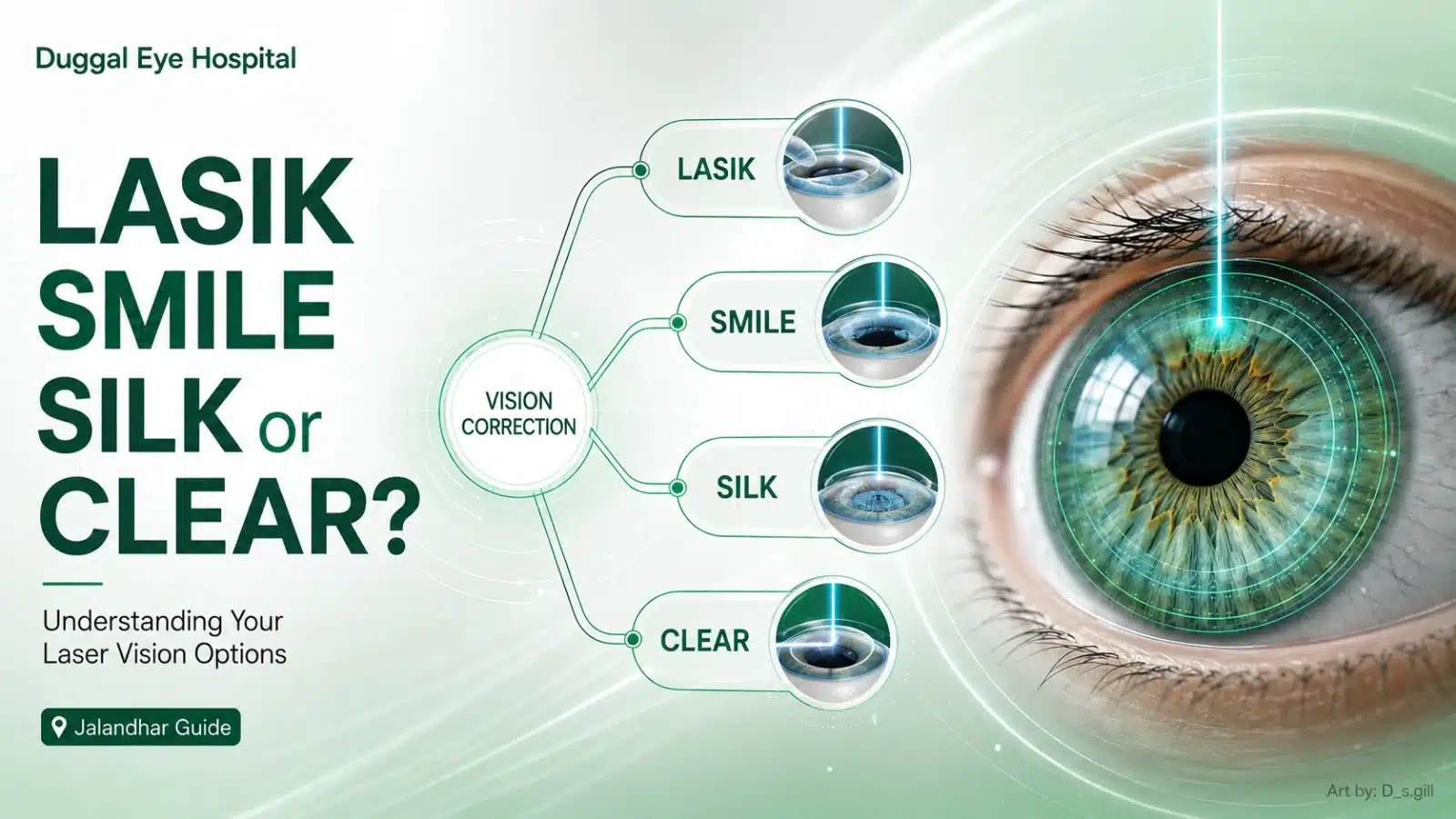
What has changed, over the past decade, is not just the demand for laser vision correction — it is the sheer number of options available to a patient walking into a consultation room. Ask five different people in Jalandhar what “laser eye surgery” means, and the answers may not agree: LASIK, SMILE, Femto-LASIK, Contoura Vision, SILK, CLEAR. The terminology has multiplied faster than most patients’ understanding of it.
Which raises the real question — the one this article is actually about:
If several laser vision correction procedures exist, how do you know which one belongs on your eyes?
That is not a question a brand name can answer. It depends on your cornea, your refractive error, your lifestyle, and a proper diagnostic assessment — not on which laser happens to be trending this year.
Laser Vision Correction Is No Longer Just LASIK
For much of the last two decades, “LASIK” was the word Doaba patients used the way people use “Xerox” for photocopying — a brand name standing in for an entire category. That is no longer accurate. LASIK is now one member of a growing family of refractive procedures, each built on a different way of reshaping the cornea to correct how light focuses on the retina.
Broadly, refractive laser procedures fall into three conceptual groups: surface ablation, where the laser treats the cornea’s outer surface directly; flap-based procedures, where a thin corneal flap is created and lifted before the laser reshapes the tissue underneath; and lenticule-based procedures, a newer approach where a laser shapes a small piece of tissue inside the cornea, removed through a very small incision — without creating a traditional flap at all. Understanding which group a procedure belongs to is often more useful for a patient than memorising brand names.
Surface Ablation — PRK and TransPRK
Surface ablation is, in some ways, the original modern refractive procedure — and it remains clinically relevant today, not as a fallback, but as a genuinely appropriate choice for selected patients. In PRK (photorefractive keratectomy) and its more automated variant, TransPRK, the excimer laser reshapes the cornea’s surface directly, without lifting a flap.
Because no flap is created, healing works differently: the surface epithelium regenerates over several days, and visual recovery is generally more gradual than with flap-based procedures. Surface ablation is frequently considered for patients with thinner corneas, certain corneal surface characteristics, or specific occupational and lifestyle factors where avoiding a corneal flap altogether may be advantageous. As with every procedure in this article, suitability is determined individually — never assumed
LASIK and Femto-LASIK
Conventional LASIK and its more modern variant, Femto-LASIK, involve creating a thin, hinged corneal flap before the excimer laser reshapes the underlying tissue. In Femto-LASIK, a femtosecond laser — rather than a mechanical microkeratome blade — creates this flap, which is why the procedure is often described as “bladeless” at the flap-creation stage. The flap is then repositioned at the end of the procedure, without stitches.
The appeal of flap-based LASIK centres largely on rapid visual recovery, often within a day. Customised approaches — including topography-guided and wavefront-guided LASIK, discussed further below — allow treatment to be tailored to the specific irregularities of an individual cornea, rather than applying a generic correction.
SMILE and SMILE Pro
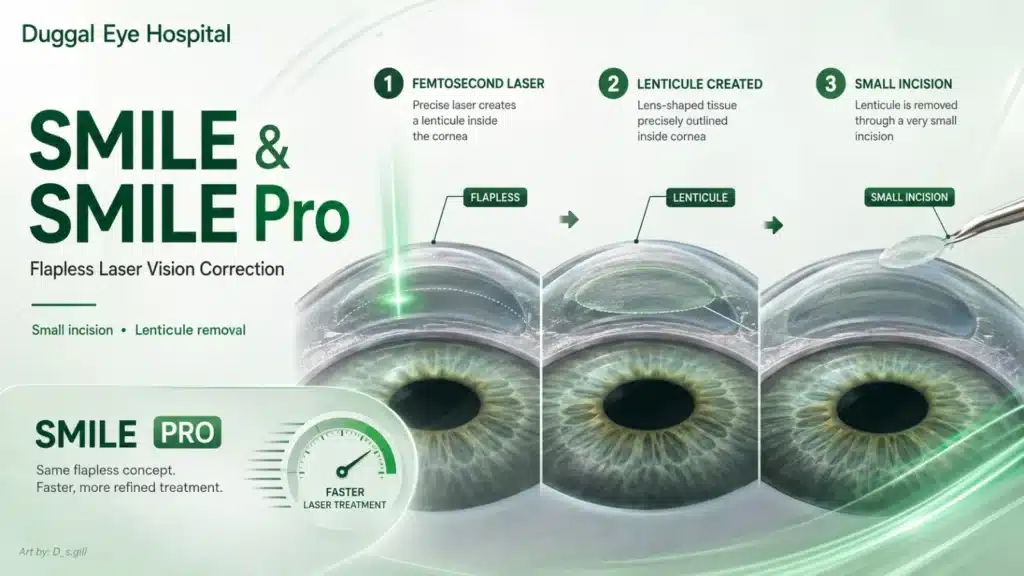
SMILE (Small Incision Lenticule Extraction) represented a genuine shift in refractive surgery thinking. Instead of creating a flap, a femtosecond laser shapes a small, lens-like piece of tissue — a lenticule — within the intact cornea. This lenticule is then removed through an incision typically only a few millimetres wide. SMILE Pro is a faster, more refined evolution of the same underlying concept, with a shorter laser treatment time.
Because SMILE and SMILE Pro do not require a flap, patients are often drawn to the idea of a more flapless experience with less disruption to the corneal surface and nerve structure. This is a genuine technology characteristic, not a guarantee — outcomes still depend heavily on individual eye characteristics, and SMILE is not automatically the correct choice for every refractive profile. It is one well-established option among several.
SILK and Modern Lenticule Extraction
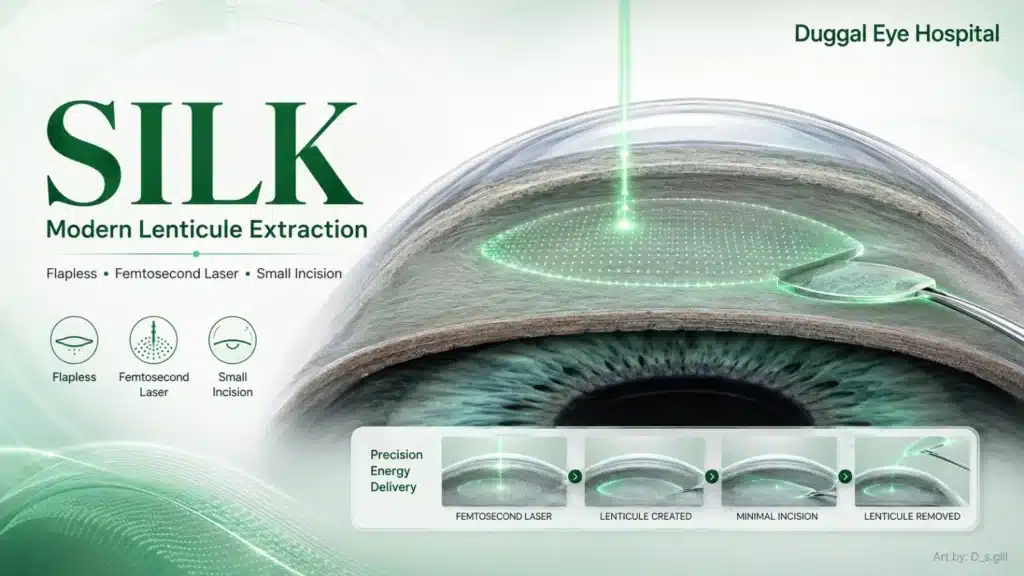
SILK represents a further development within the lenticule-extraction family — a femtosecond-laser-based approach that, like SMILE, avoids a traditional corneal flap in favour of shaping and removing a small lenticule of tissue through a minimal incision. As with any lenticule-based platform, the underlying principle rests on precise, controlled femtosecond laser energy delivering tissue removal with minimal disruption to surrounding structures.
It is worth being precise about what can, and cannot, be said here: platform-specific characteristics — such as laser spot pattern, energy delivery, or incision dimensions — are technology characteristics. They describe how a laser is engineered to behave. They are not, by themselves, guarantees of a particular patient outcome, which continues to depend on the individual cornea being treated.
CLEAR by Ziemer
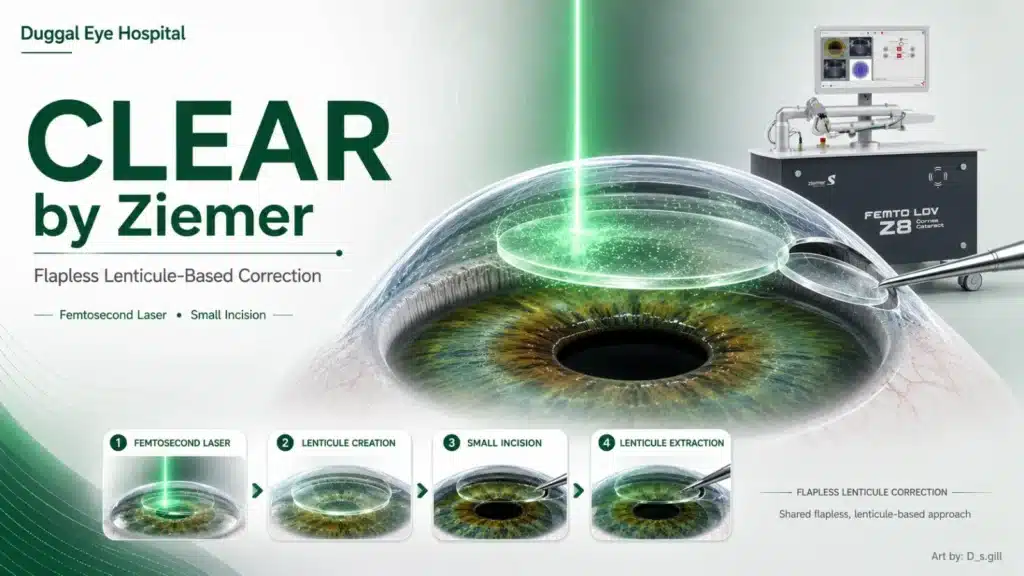
CLEAR is another legitimate, modern lenticule-based refractive procedure, built on the Ziemer platform. Like SMILE and SILK, it works on the principle of femtosecond-laser lenticule creation and extraction through a small incision, without a conventional flap.
CLEAR, SMILE and SILK share a common surgical philosophy — flapless, lenticule-based correction — while differing in the specific laser platform and delivery characteristics behind each. None of the three is universally “better” than the others in the abstract; each represents a genuine, viable option whose appropriateness is determined by the individual eye being evaluated, not by platform marketing.
Contoura Vision and Wavefront — When Customised Correction Matters
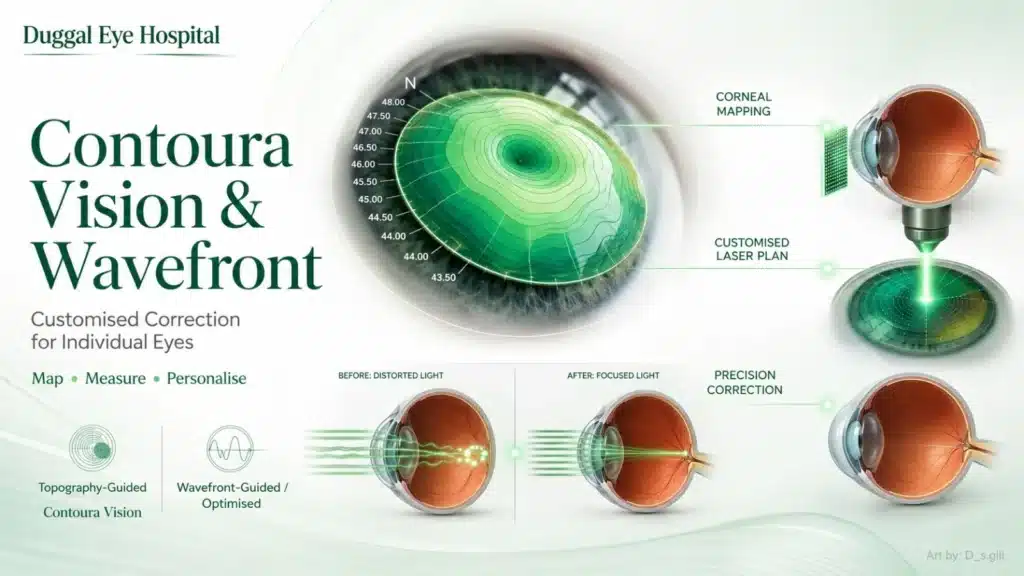
Every cornea is, in a very literal sense, unique — not just in overall refractive power, but in its micro-level irregularities. Two people with an identical spectacle prescription can, after detailed assessment, turn out to have meaningfully different corneal surfaces. Standard refractive treatment corrects the prescription; customised treatment goes further.
Wavefront-guided and Wavefront-optimised treatments use detailed measurements of how light actually travels through an individual eye to guide the laser, addressing subtle optical irregularities — known as higher-order aberrations — that a generic, prescription-based treatment may not fully address. Topography-guided treatment, including Contoura Vision, uses detailed mapping of the cornea’s surface shape for a related purpose.
The underlying idea is simple to state, even where the optics are not: customised treatment accounts for the characteristics of an individual eye, rather than simply applying a generic spectacle prescription to the cornea. Whether this level of customisation is necessary — and which customised approach is most appropriate — is, again, a decision made after assessment, not a default upgrade every patient requires.
Before the Laser Touches Your Eye, Comes the Map
If there is one idea this article would like every reader to leave with, it is this: sophisticated refractive surgery begins with sophisticated diagnosis — not with choosing a brand name.
A proper refractive evaluation is not a five-minute vision check. It is a structured diagnostic sequence, each stage of which either confirms or rules out candidacy for specific procedures.
Refraction
Establishing the precise refractive error — how much short-sightedness, long-sightedness or astigmatism is present, and how stable it has been over time.
Corneal Mapping
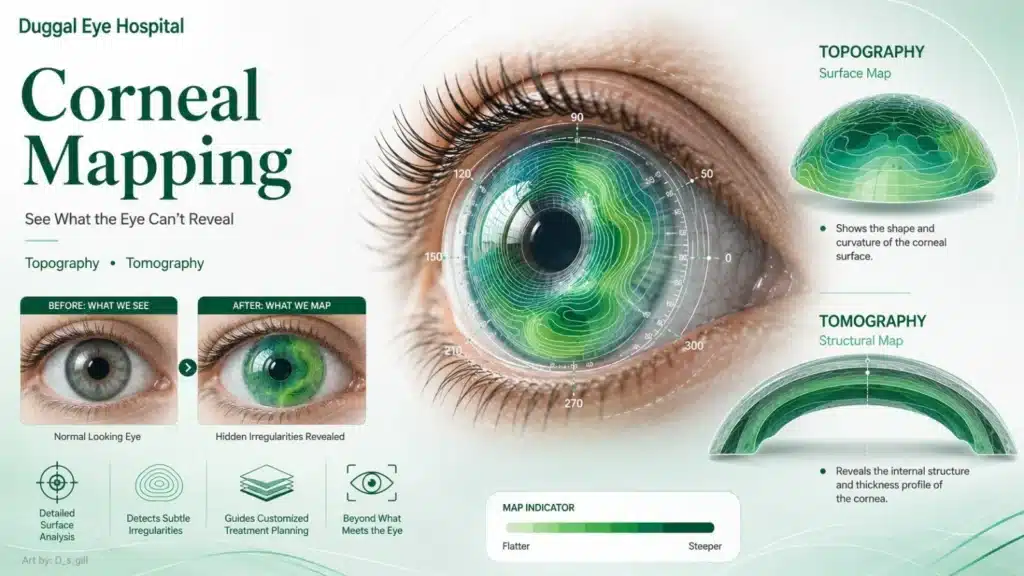
Corneal topography, and where relevant tomography, create a detailed surface and structural map of the cornea, revealing irregularities invisible to the naked eye or a basic vision test.
Corneal Thickness and Shape
Measured through pachymetry, corneal thickness is one of the most important factors determining which procedures are biomechanically appropriate for a given eye.
Ocular Surface Assessment
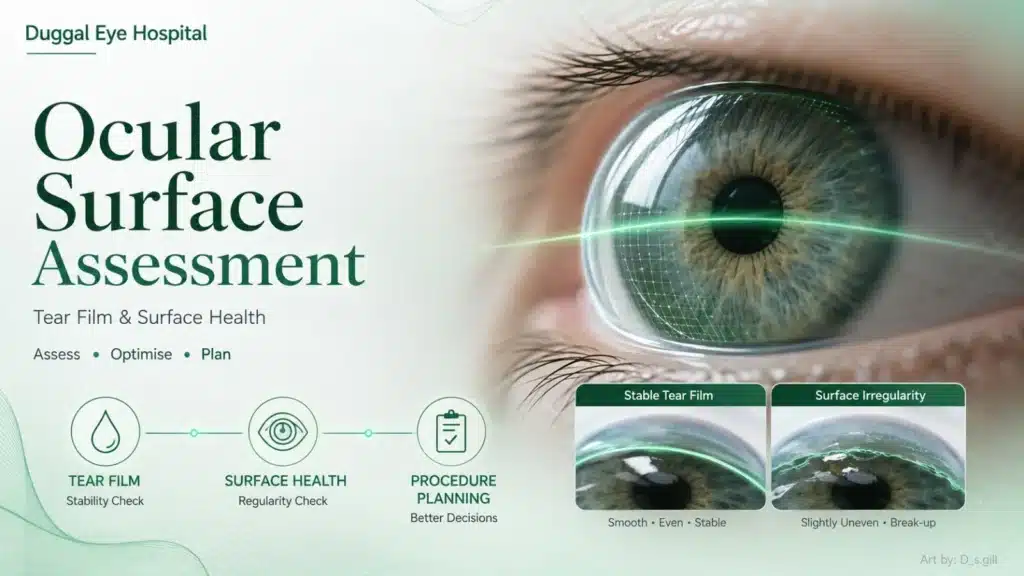
Tear film stability and overall ocular surface health are assessed, since dry eye and surface irregularities can influence both procedure choice and recovery.
Final Suitability Assessment
Only once refraction, corneal structure, thickness, shape and ocular surface health have all been assessed does a genuinely informed procedure recommendation become possible. This sequence — not a brand preference — is what separates a considered surgical recommendation from a generic one.
Which Laser Procedure Is Right for You?
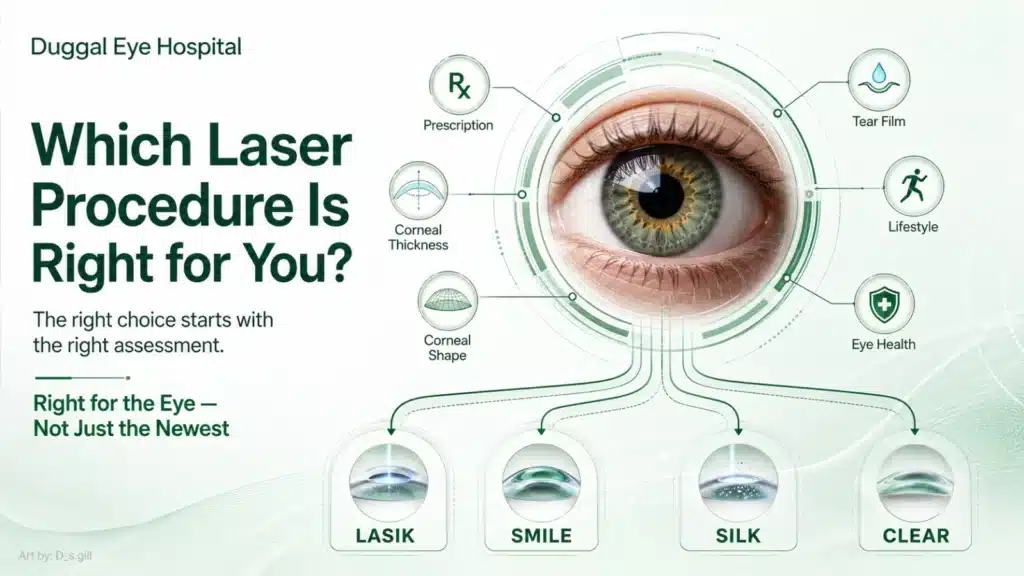
There is no universal answer to “which laser procedure is best” — and any source claiming otherwise is oversimplifying a genuinely individual decision.
The right procedure for a given eye depends on a combination of factors:
- Refractive error and its stability over time
- Corneal thickness
- Corneal shape and biomechanics, where relevant
- Ocular surface health and tear-film stability
- Pupil characteristics, where relevant
- Age and prescription stability
- Lifestyle and occupational needs
- Previous eye conditions or surgery
- Realistic patient expectations
Two patients with near-identical spectacle prescriptions can, after proper evaluation, be recommended two entirely different procedures — not because one hospital is more advanced than another, but because their corneas are simply not the same. The best laser procedure is not necessarily the newest laser procedure. It is the procedure that is appropriate for that particular eye.
Why Experience Matters in Refractive Surgery
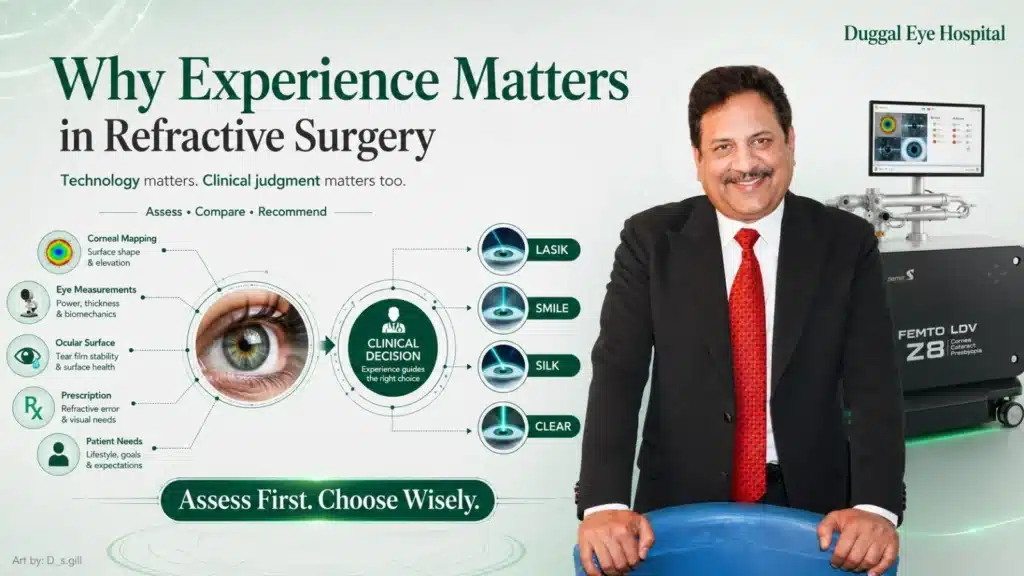
Technology explains what a procedure can do. Experience explains when it should — and should not — be used.
Dr Sanjeev Duggal, MS Ophthalmology, is the lead eye surgeon at Duggal Eye Hospital, Jalandhar, where he has been providing ophthalmic clinical and surgical care since the 1990s. Dr Duggal’s approach to refractive surgery reflects the theme running through this article: that procedure selection should follow a comprehensive diagnostic assessment of the individual eye, not a default recommendation applied uniformly to every patient.
Patients researching “best LASIK surgeon in Jalandhar” are often, without quite realising it, searching for a proxy answer to a more specific question: what should I actually look for? A useful evaluation considers a surgeon’s clinical experience, appropriate training, diagnostic capability, the range of procedures genuinely offered rather than a single default option, how thoroughly patient selection and informed consent are handled, the structure of post-operative follow-up, facility standards, and the ability to recognise and manage complications or alternative approaches when they arise. For patients across Jalandhar and the wider Doaba region, this distinction — between a hospital offering one procedure to everyone and one equipped to assess, compare and recommend across multiple established technologies — is often more relevant to long-term outcomes than any single laser’s marketing.
Why Patients From Across Doaba Consider Jalandhar for Advanced Eye Care
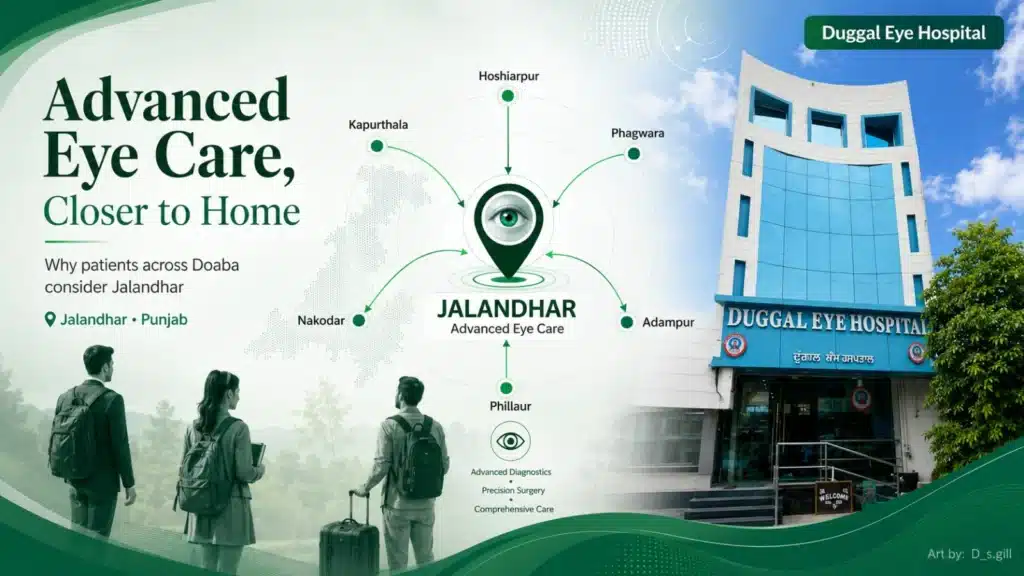
Jalandhar sits at the centre of the Doaba region, within reach of Hoshiarpur, Kapurthala, Phagwara, Nakodar, Adampur, Phillaur and the surrounding towns that make up this part of Punjab. For many patients in these areas, the practical question is not only which procedure is right for them, but where they can access a comprehensive diagnostic and surgical setup without travelling to Chandigarh, Delhi, or further afield.
Consider, illustratively (not as reported patient cases): a young professional working in Jalandhar who has spent years managing contact lens discomfort during long working hours; a student from Hoshiarpur who has researched LASIK, SMILE and SILK online and arrives at a consultation already carrying more questions than most patients twice their age; or an NRI, visiting family in Kapurthala, who assumed advanced lenticule-based procedures were only available overseas and is glad to find otherwise. These scenarios are illustrative, not individual case studies — but they reflect the kind of decision-making process that brings patients from across the Doaba belt to evaluate their options in Jalandhar.
Duggal Eye Hospital's Refractive Vision Correction Ecosystem
Duggal Eye Hospital, Jalandhar, positions itself as a NABH-accredited super-specialty eye hospital offering an advanced LASIK and refractive laser centre, under the clinical leadership of Dr Sanjeev Duggal.
NABH accreditation status, category and validity
directly against the live NABH directory or certificate before publishing this claim.
Do not publish a specific accreditation number or expiry date unless independently verified.
Rather than a single-procedure clinic, the hospital’s refractive services span the breadth of technologies discussed in this article — from surface ablation to flap-based LASIK to lenticule-based procedures — supported by the diagnostic infrastructure necessary to properly assess candidacy for each. This combination — diagnostic depth, procedural breadth, and surgeon experience — rather than any single laser brand, is what patients across Jalandhar and the Doaba region are encouraged to evaluate directly with the clinical team.
The Refractive Technology Landscape
Comparison: PRK / LASIK / SMILE / SMILE Pro / SILK / CLEAR
| Feature | PRK / TransPRK | LASIK / Femto-LASIK | SMILE | SMILE Pro | SILK | CLEAR |
|---|---|---|---|---|---|---|
| Basic concept | Surface ablation | Flap + excimer ablation | Lenticule extraction | Lenticule extraction (faster laser step) | Lenticule extraction | Lenticule extraction |
| Corneal flap | No | Yes | No | No | No | No |
| Laser type | Excimer laser | Excimer laser (+ femtosecond for flap) | Femtosecond laser | Femtosecond laser | Femtosecond laser | Femtosecond laser (Ziemer platform) |
| Tissue access | Full surface treated directly | Flap lifted; stromal bed treated | Small incision (~2–4mm) | Small incision | Small incision | Small incision |
| Recovery pattern | Gradual, several days | Often rapid, within 1 day | Procedure-dependent, generally gradual-to-fast | Similar to SMILE | Procedure-dependent | Procedure-dependent |
| Patient selection | Individual assessment required | Individual assessment required | Individual assessment required | Individual assessment required | Individual assessment required | Individual assessment required |
Frequently Asked Questions
LASIK is a well-established refractive procedure with decades of clinical use worldwide. Like any surgical procedure, it carries risks and is not appropriate for every eye — safety and suitability are determined through comprehensive pre-operative assessment, not assumed in advance.
Neither is universally “better.” SMILE and LASIK are built on different surgical concepts — flapless lenticule extraction versus flap-based ablation — and each may be more appropriate depending on an individual’s corneal characteristics, refractive error and lifestyle.
Both use the same lenticule-extraction concept. SMILE Pro is a more recent, refined version of the underlying technology, generally associated with a shorter femtosecond laser treatment time.
SILK is a femtosecond-laser-based lenticule-extraction procedure, conceptually similar to SMILE, in which a small lenticule of corneal tissue is shaped and removed through a minimal incision without a traditional flap.
CLEAR is a lenticule-based refractive procedure performed on the Ziemer laser platform, following the same flapless, small-incision surgical philosophy as SMILE and SILK.
Contoura Vision is a topography-guided, customised approach designed to account for an individual cornea’s surface irregularities, rather than a generic prescription-based treatment. Whether this customisation is advantageous for a specific eye depends on that eye’s own corneal mapping results.
The corneal flap in Femto-LASIK is created using a femtosecond laser rather than a mechanical blade, which is why the flap-creation step is described as bladeless. The excimer laser is then used for the reshaping stage itself.
This depends heavily on corneal thickness and shape relative to the degree of correction required. Higher refractive errors need closer evaluation, and not every eye with high power will be suitable for every procedure.
Corneal thickness is one of the most important factors in procedure selection. Thinner corneas may still be candidates for certain procedures, including some forms of surface ablation, but this must be confirmed through pachymetry and full corneal assessment rather than assumed.
Recovery timelines vary by procedure — flap-based LASIK is often associated with faster initial visual recovery, while surface ablation typically involves a more gradual healing process. Individual healing also varies.
Temporary dry eye symptoms are a recognised possibility after refractive surgery and are assessed as part of both pre-operative screening and post-operative care. Pre-existing ocular surface conditions are evaluated before procedure selection for this reason.
Many patients achieve significant spectacle independence after successful refractive surgery, though outcomes vary by individual, and some patients may still need glasses for specific tasks or as they age. No procedure can guarantee a permanent, universal outcome.
Through a structured diagnostic sequence — refraction, corneal mapping, corneal thickness and shape assessment, ocular surface evaluation, and a final suitability review — rather than a default recommendation applied to every patient.
Corneal topography and tomography reveal structural details and irregularities that a standard vision test cannot detect, and directly inform which procedures are appropriate, and how they should be planned, for an individual eye.