

Glaucoma, or kalamotia as commonly known in the Indian subcontinent, treatment has changed considerably over the years. The old picture of glaucoma care—check eye pressure, prescribe drops, review later—no longer tells the whole story.In 2026, glaucoma management is more individual. Glaucoma specialists look at the optic nerve, visual field, OCT changes, eye pressure, angle anatomy, rate of progression, and the patient’s ability to stay on treatment before deciding what to do next.
That matters because glaucoma can damage vision quietly.Once lost, the damaged optic-nerve tissue cannot simply be restored.Treatment therefore aims to prevent or slow further damage, primarily by lowering eye pressure to a level appropriate for that particular eye. The latest American Academy of Ophthalmology guideline continues to identify IOP reduction as central to management, including in normal-tension glaucoma.
At Duggal Eye Hospital, Jalandhar, glaucoma assessment and treatment are provided within a NABH-accredited super-specialty eye-care setting by glaucoma specialists under the clinical oversight of Dr. Sanjeev Duggal, Chief Eye Surgeon and Medical Director.
What is glaucoma?
Glaucoma is not one single disease. It is a group of eye conditions in which the optic nerve becomes damaged, often in association with elevated intraocular pressure (IOP).
The common forms include:
- Primary open-angle glaucoma
- Primary angle-closure glaucoma
- Normal-tension glaucoma
- Secondary glaucoma, including glaucoma associated with steroids, inflammation, trauma, diabetes or other eye conditions
- Congenital and childhood glaucoma
The treatment depends heavily on which type is present.
A pressure reading by itself cannot diagnose glaucoma. Some people develop glaucoma despite pressures that fall within the statistically normal range, while others have high eye pressure without optic-nerve damage.
Why glaucoma treatment is not simply about “normalising” eye pressure?
There is no universal safe IOP number that applies equally to every patient.
A person with established glaucoma may need a substantially lower pressure than someone who merely has ocular hypertension. The required target also depends on factors such as:
- Existing optic-nerve damage
- Visual-field loss
- Rate of progression
- Age and life expectancy
- Corneal characteristics
- Glaucoma subtype
- Other eye diseases
- The fellow eye
- Previous response to treatment
The target pressure can therefore change as the disease evolves.
Indian clinical guidance also emphasises establishing a target IOP using clinical examination and visual-field assessment and reviewing patients periodically once that target is achieved.
The goal is not a particular number on the tonometer. The goal is protecting useful vision for the long term.
How is glaucoma diagnosed before treatment begins?
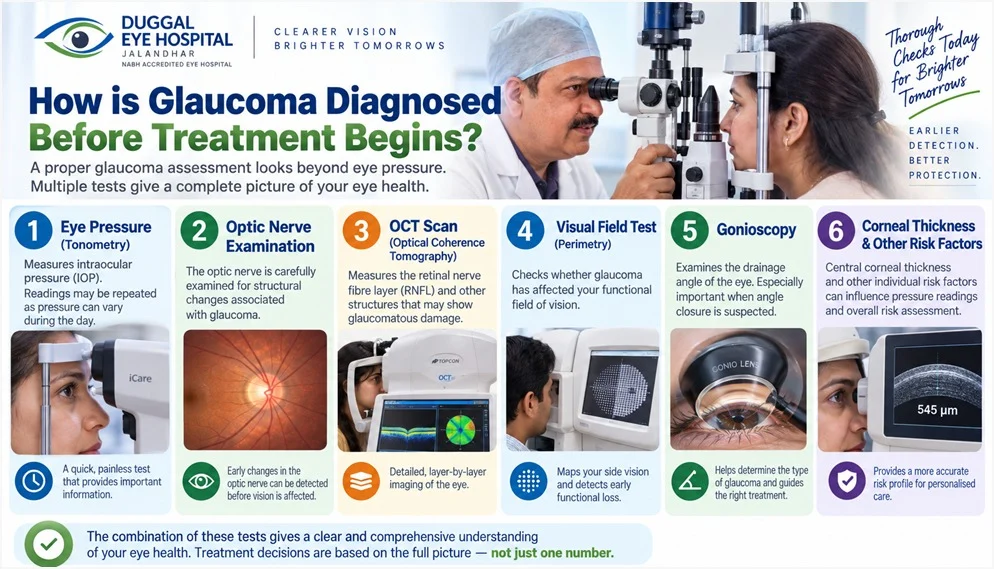
A good glaucoma assessment involves considerably more than checking eye pressure.
Depending on the patient, an ophthalmologist may assess:
- Eye pressure
Tonometry measures IOP. Measurements may need to be repeated because pressure varies during the day.
- Optic nerve
The optic nerve is examined for structural changes associated with glaucoma.
- OCT
Optical coherence tomography (OCT) can measure the retinal nerve fibre layer and other structures that may show glaucomatous damage.
- Visual field
Perimetry checks whether glaucoma has affected the patient’s functional field of vision.
- Gonioscopy
This examines the drainage angle and is particularly important when angle closure is suspected.
- Central corneal thickness and other risk factors
These can influence interpretation of pressure measurements and overall risk assessment.The combination matters. Indian glaucoma guidance describes diagnosis as involving clinical examination, gonioscopy, tonometry, visual-field testing and assessment of the optic nerve, RNFL and macula rather than relying on one measurement.
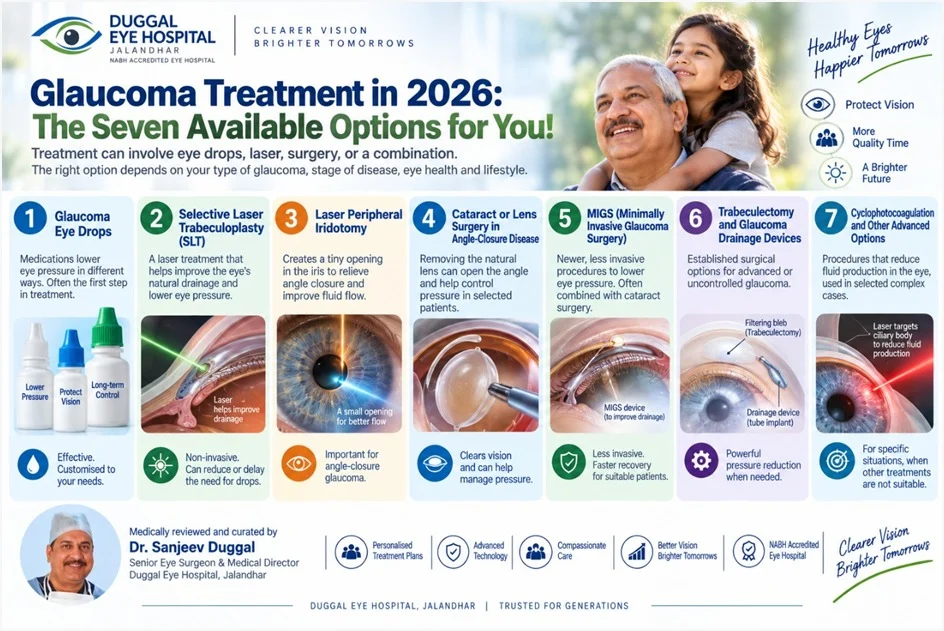
Glaucoma Treatment in 2026: TheSeven available Options for you !
Treatment can involve eye drops, laser, surgery, or a combination.
- Glaucoma eye drops
- Selective Laser Trabeculoplasty (SLT)
- Laser Peripheral Iridotomy for Angle-Closure Glaucoma
- Cataract or Lens Surgery in Angle-Closure Disease
- MIGS: Where Does It Fit in 2026?
- Trabeculectomy and Glaucoma Drainage Devices
- Cyclophotocoagulation and Other Advanced Options
Prostaglandin analogues
Drugs such as latanoprost, bimatoprost and travoprost are widely used for open-angle glaucoma and ocular hypertension. They increase aqueous outflow and are often convenient because many are used once daily.
Prostaglandin analogs remain an important first-choice medication class in open-angle glaucoma.
Other medicines
Depending on the required pressure reduction and the patient’s medical history, an ophthalmologist may use:
- Beta-blockers
- Carbonic anhydrase inhibitors
- Alpha-agonists
- Miotics
- Combination drops
Newer drug combinations also remain part of the treatment landscape. For example, the FDA-approved fixed combination of netarsudil and latanoprost lowers IOP through two different mechanisms and is indicated for open-angle glaucoma or ocular hypertension.
The choice is not simply about which drop lowers pressure most. The doctor also considers tolerability, dosing frequency, ocular-surface health, other medical conditions, interactions, affordability and whether the patient can use the drops consistently.
2. Selective Laser Trabeculoplasty (SLT)
One of the most significant changes in the modern glaucoma conversation is the role of SLT.
SLT uses laser energy directed at the trabecular meshwork—the drainage tissue through which aqueous fluid leaves the eye. Its purpose is to improve aqueous outflow and lower IOP.
For appropriately selected patients with open-angle glaucoma or ocular hypertension, SLT can be used instead of, before, or alongside medication, depending on the clinical situation.
NICE recommends 360° SLT as an initial option for newly diagnosed, non-advanced chronic open-angle glaucoma and for specified patients with ocular hypertension. It also notes that the effect can diminish over time and that repeat treatment may sometimes be considered.
Long-term results from the LiGHT trial have added to the evidence supporting SLT-first care. A six-year analysis published in 2025 found slower visual-field progression in the SLT-first group than in the drops-first group, particularly in mild disease.
That does not mean every glaucoma patient should have SLT.
The drainage angle, glaucoma subtype, severity, previous treatment and target IOP all matter.
3. Laser Peripheral Iridotomy for Angle-Closure Glaucoma
Open-angle and angle-closure glaucoma are not managed in the same way.
When the drainage angle is dangerously narrow or closed because of mechanisms such as pupillary block, a laser peripheral iridotomy (LPI) may be required.
The laser creates a tiny opening in the iris to provide an alternative pathway for aqueous movement and relieve pupillary-block mechanisms.
Indian treatment guidance specifically identifies iridotomy as an important treatment for primary angle-closure disease.
Some patients may subsequently require additional treatment, including lens extraction or pressure-lowering therapy, depending on the anatomy and degree of glaucoma damage.
4. Cataract or Lens Surgery in Angle-Closure Disease
In some patients with angle-closure disease, the natural lens contributes significantly to crowding of the anterior segment.
Removing the lens can deepen the anterior chamber and open the drainage angle. For selected patients, lens extraction therefore becomes part of glaucoma management rather than simply cataract treatment.
The decision depends on the anatomy, extent of angle closure, IOP, optic-nerve damage and other clinical factors.
It should not be reduced to the idea that “cataract surgery cures glaucoma.” It may be highly relevant in selected angle-closure cases, but glaucoma still requires appropriate follow-up.
5. MIGS: Where Does It Fit in 2026?
Minimally invasive glaucoma surgery (MIGS) has expanded the surgical choices available to selected patients, particularly those with mild-to-moderate open-angle glaucoma.
MIGS procedures are designed to lower IOP with less tissue disruption than traditional filtering surgery. Some are performed through the trabecular pathway; others use different routes for aqueous drainage.
They can be particularly relevant when:
- Medication burden is becoming difficult
- IOP remains above target
- A patient is already undergoing cataract surgery
- The disease severity and anatomy are appropriate for a MIGS procedure
But MIGS is not a replacement for every glaucoma operation.
Evidence reviews continue to show that different MIGS procedures have different levels of evidence, effectiveness and indications.
For more advanced glaucoma requiring a very low target pressure, a traditional filtering procedure may still provide the degree of pressure reduction needed.
6. Trabeculectomy and Glaucoma Drainage Devices
When glaucoma is advanced, progressing or inadequately controlled despite other measures, more powerful surgery may be required.
Trabeculectomy
Trabeculectomy creates a controlled pathway for aqueous fluid to leave the eye and lower IOP.
It remains one of the established high-efficacy glaucoma operations, particularly when substantial pressure reduction is required.
Glaucoma drainage devices
Tube or drainage-implant surgery provides another route for aqueous drainage and may be considered in selected complex or refractory cases.
The decision between trabeculectomy, a drainage device and other surgical options depends on the glaucoma subtype, severity, previous surgery, conjunctival condition, target pressure and the surgeon’s assessment.
7. Cyclophotocoagulation and Other Advanced Options
When conventional treatment has not provided adequate control—or in selected eyes where traditional surgery is unsuitable—procedures targeting the ciliary body, which produces aqueous fluid, may be considered.
Cyclophotocoagulation and newer variations have expanded the surgical toolbox.
These procedures are generally reserved for specific clinical situations rather than used routinely for newly diagnosed glaucoma.
What Happens When Eye Drops Stop Working?
This is a common point of confusion.
Needing another treatment does not automatically mean the previous treatment failed.
Glaucoma can progress despite an initially successful treatment because:
- The disease itself has changed
- The target IOP has become lower
- The medication is no longer sufficient
- The response has diminished
- The patient cannot tolerate the medication
- Drops are not reaching the eye correctly
- The treatment burden has affected adherence
A patient whose glaucoma is progressing needs a fresh assessment rather than simply adding another bottle.
Sometimes the answer is another medication. Sometimes it is SLT. Sometimes surgery is more appropriate.
Does Glaucoma Surgery Restore Lost Vision?
No.This is one of the most important things for patients and families to understand.Glaucoma treatment is primarily about preserving the vision that remains.
If optic-nerve damage has already caused permanent visual-field loss, lowering IOP does not normally bring that lost field back. Treatment starts early and continues consistently to reduce the risk of further damage. That makes early detection particularly valuable.
What About Normal-Tension Glaucoma?
A “normal” pressure reading does not rule out glaucoma.
Some patients develop characteristic optic-nerve and visual-field damage even though their IOP measurements are not unusually high.
The 2026 AAO guideline specifically recognises normal-tension glaucoma and states that lowering IOP can still be beneficial in these patients.
This is another reason not to rely on an eye-pressure reading alone.
How Often Should a Glaucoma Patient Be Checked?
There is no universal six-month or one-year rule.
Follow-up intervals depend on:
- Disease severity
- Rate of progression
- IOP control
- Medication changes
- Visual-field status
- OCT findings
- Surgical or laser treatment
- Risk of further damage
Someone with stable early disease may require a different schedule from a patient with advanced or rapidly progressing glaucoma.
The important thing is continuity. Missing repeated glaucoma reviews because vision “feels fine” can be risky. Glaucoma may continue to progress without producing obvious day-to-day symptoms.
When Should You Get Checked for Glaucoma?
A glaucoma evaluation deserves particular attention if you:
- Are 40 or older
- Have a parent, sibling or child with glaucoma
- Have diabetes
- Have significant myopia
- Have previously been told your eye pressure is high
- Have used steroid medicines for a prolonged period
- Have had an eye injury or previous eye surgery
- Have been told you have narrow angles
- Have unexplained visual-field abnormalities
ICMR’s glaucoma treatment workflow recommends screening from age 40 and earlier or more carefully in people with a family history.
If you experience sudden severe eye pain, blurred vision, halos around lights, headache, nausea or vomiting, especially with a red eye, seek urgent ophthalmic assessment. Acute angle closure can be an emergency.
Glaucoma Treatment in 2026: The Practical Takeaway
Modern glaucoma treatment is no longer a simple choice between “drops or surgery.”
Depending on the type and stage of glaucoma, treatment may involve:
Eye drops → SLT → angle-closure laser → lens surgery → MIGS → trabeculectomy or drainage-device surgery → advanced pressure-lowering procedures
But that sequence is not a fixed ladder.
A patient with early open-angle glaucoma may reasonably begin with SLT or medication. Another may need surgery much earlier because of advanced damage or a very low target pressure. A patient with angle closure follows a different pathway altogether.
The right treatment achieves the required pressure control while accounting for optic nerve health, disease stage, treatment tolerance, adherence, anatomy, and long-term needs.
At Duggal Eye Hospital, Jalandhar, glaucoma evaluation and treatment are provided within a super-speciality ophthalmic setting, with medical oversight from Dr. Sanjeev Duggal, Senior Eye Surgeon and Medical Director.
The most useful glaucoma treatment is not necessarily the newest one. It is the treatment that protects the patient’s remaining vision—and is sustained over time.
Medical review:
Dr. Sanjeev Duggal, MS Ophthalmology — Senior Eye Surgeon & Medical Director, Duggal Eye Hospital, Jalandhar.
Frequently Asked Questions
There is currently no treatment that reliably reverses established glaucomatous optic-nerve damage. Treatment is directed at controlling the disease and reducing the risk of further vision loss.
No. Normal-tension glaucoma can occur despite IOP readings that are not unusually high.
No. Depending on the glaucoma type and stage, treatment may include SLT, laser iridotomy, lens surgery, MIGS, trabeculectomy, drainage devices or other pressure-lowering procedures.
There is no universal answer. SLT is an established option for appropriately selected open-angle glaucoma and ocular-hypertension patients. Evidence from the LiGHT trial supports SLT-first treatment in suitable newly diagnosed patients, but individual anatomy and disease severity still determine the appropriate choice.
Treatment generally cannot restore visual-field loss caused by established optic-nerve damage. Its purpose is to prevent or slow further deterioration.
Not without your ophthalmologist’s advice. Some patients require fewer drops after SLT, while others still need medication or additional treatment.
MIGS is useful in selected patients, particularly in mild-to-moderate disease, but advanced glaucoma may require procedures capable of achieving a much lower IOP. The choice depends on the individual eye.
Often, yes. A detailed examination combining optic-nerve assessment, OCT, visual-field testing, IOP measurement and angle assessment can identify glaucoma or significant risk before a patient notices obvious vision loss.